How Smart Contracts Are Revolutionizing Royalties for Digital Collectors and Creators

For decades, artists have watched their work resell for millions while they received nothing. A painting changes hands at auction for ten times its original price, and the creator sees zero percent of that windfall. Traditional art markets have always operated this way, leaving artists out of the secondary market entirely. Blockchain technology and smart contracts are changing that story for digital creators.
Smart contracts royalties digital art systems automatically pay creators a percentage every time their work resells on blockchain marketplaces. These self-executing programs eliminate middlemen, reduce payment delays from months to seconds, and give artists ongoing income from their work’s appreciation. Collectors benefit from transparent provenance and verifiable ownership that increases confidence in the digital art market.
What smart contracts actually do for digital art royalties
A smart contract is a program that runs on a blockchain. Think of it as a vending machine for payments.
You put in money, select your item, and the machine executes the transaction automatically. No cashier needed. No manager approval required. The code handles everything.
For digital art, smart contracts encode royalty terms directly into the artwork’s blockchain record. When someone buys your piece on the secondary market, the contract automatically calculates your royalty percentage and sends payment to your wallet.
This happens in real time. No invoices. No payment processors. No waiting 90 days for a gallery to cut you a check.
The standard royalty rate sits between 5% and 10% for most digital art platforms. Some artists set higher rates. Others go lower to encourage trading activity. The choice belongs to the creator at minting time.
Here’s what makes this different from traditional art markets. In physical art sales, tracking resales requires manual record keeping, trust between parties, and legal enforcement. A painting might change hands privately, and the artist never knows. Even when galleries promise royalty payments, collecting them requires lawyers and patience.
Smart contracts remove that friction entirely. The blockchain records every transaction. The code enforces the payment. There’s no way to skip the royalty without breaking the entire transaction.
How royalty automation works step by step
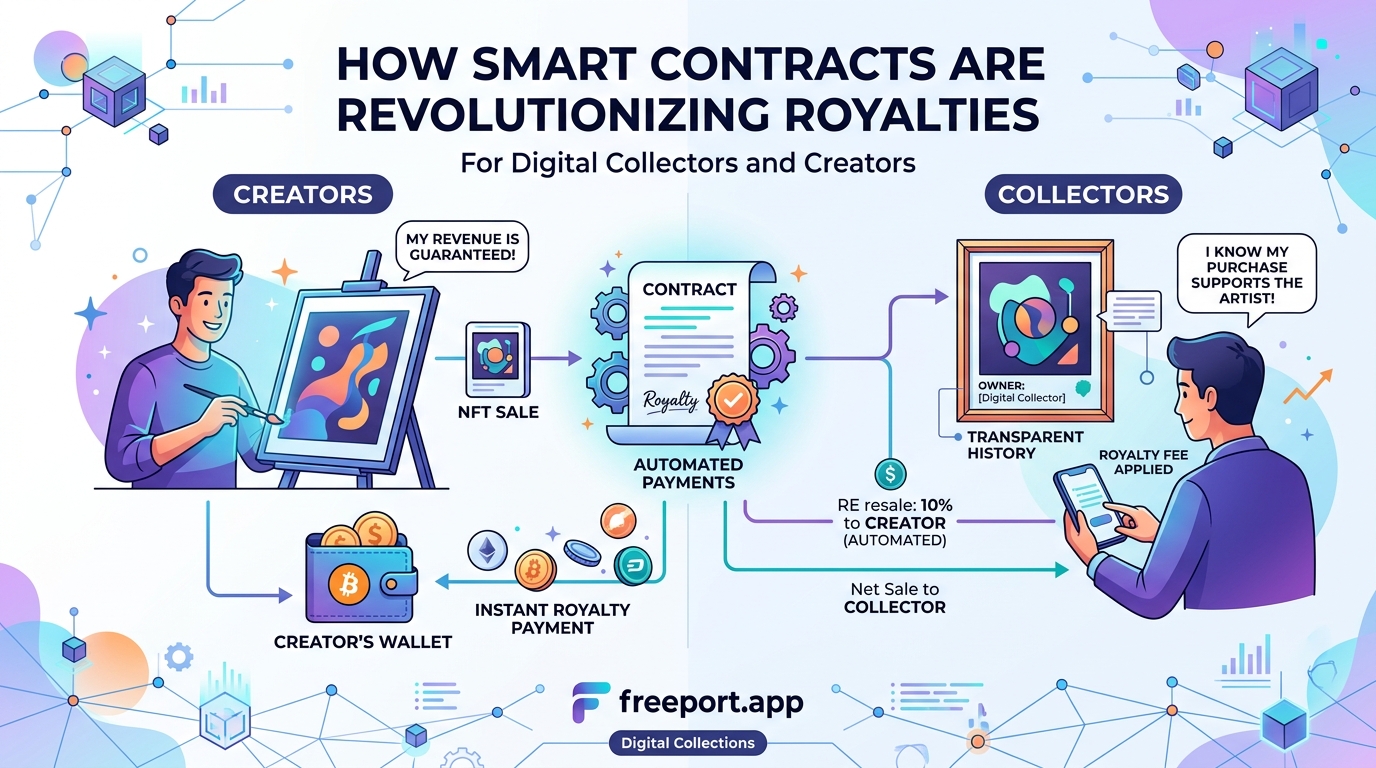
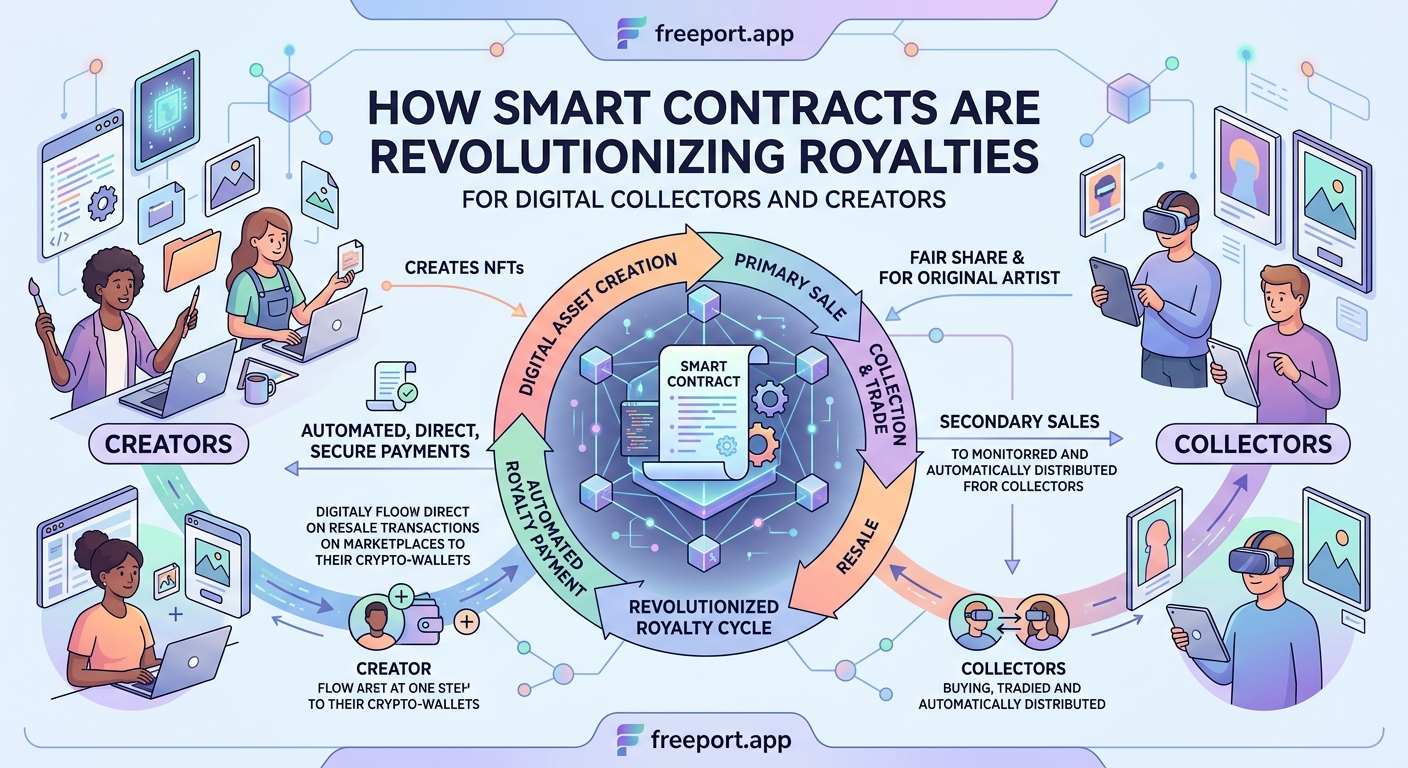
Understanding the technical process helps both creators and collectors make better decisions. Here’s exactly what happens when you mint art with royalty terms.
-
You create your digital artwork and prepare the file. Most artists work in standard formats like PNG, MP4, or GLB depending on whether the piece is static, animated, or three-dimensional.
-
You connect to a minting platform and upload your work. Platforms like Foundation, SuperRare, or others provide interfaces that don’t require coding knowledge. You set your royalty percentage during this step.
-
The platform generates a smart contract containing your royalty terms. This contract lives on the blockchain forever. It includes your wallet address, the royalty percentage, and rules for how payments split if multiple creators collaborated.
-
A collector purchases your work on the primary market. You receive the full sale price minus platform fees. The artwork now belongs to the collector, but your royalty terms remain attached.
-
The collector later resells your piece to someone else. The smart contract activates automatically. It calculates your royalty, deducts it from the sale price, sends it to your wallet, and transfers the remaining amount to the seller.
-
This process repeats for every future sale. Your great-grandchildren could still receive royalties if your work keeps trading decades from now.
The entire sequence takes seconds. Compare that to traditional art royalties, where artists might wait quarters or years to receive payment, if they receive anything at all.
When you’re minting your first fine art NFT, understanding these mechanics helps you set appropriate royalty rates and choose platforms that respect creator rights.
Why collectors benefit from transparent royalty systems
You might think automatic royalties only help artists. Actually, collectors gain significant advantages too.
Transparent royalty systems create healthier markets. When everyone knows exactly what percentage goes to the creator, pricing becomes more predictable. There are no hidden fees or surprise deductions.
This transparency builds trust. New collectors entering the space can verify that artists actually receive their royalties by checking blockchain records. Every transaction is public and auditable.
Provenance becomes ironclad. Smart contracts revolutionizing art ownership and provenance means collectors can prove authenticity and ownership history without relying on paper certificates or expert opinions.
Here’s a practical example. You buy a digital artwork for 1 ETH. The artist set a 10% royalty. You hold it for two years, and it appreciates. You sell for 5 ETH. The smart contract automatically sends 0.5 ETH to the artist and 4.5 ETH to you.
Everyone knows the math ahead of time. No disputes. No delayed payments. No lawyers.
This certainty makes collectors more willing to pay premium prices. When you know the artist benefits from future appreciation, you’re supporting a sustainable creative ecosystem. Many collectors specifically seek out work from blockchain artists redefining contemporary digital art because they want to participate in that support system.
Common royalty structures and what they mean
Not all smart contracts handle royalties the same way. Understanding the variations helps you make informed decisions as either a creator or collector.
| Royalty Type | How It Works | Best For |
|---|---|---|
| Fixed percentage | Same rate applies to every resale regardless of price | Most digital art, simple to understand |
| Tiered rates | Percentage decreases as sale price increases | High-value pieces that might appreciate significantly |
| Capped royalties | Maximum dollar amount per transaction | Protecting collectors from excessive fees on expensive sales |
| Split royalties | Multiple creators or collaborators share the percentage | Collaborative works, artist collectives |
| Declining royalties | Percentage decreases over time or number of sales | Encouraging long-term holding and trading |
Fixed percentage royalties dominate the current market. They’re simple to program, easy to understand, and fair across different price points.
Tiered rates make sense for artists who expect their work to appreciate dramatically. A 10% royalty on a $100,000 sale might feel excessive to collectors, so some artists program lower percentages for higher price brackets.
Split royalties work perfectly for collaborations. Two artists can program a 10% total royalty that automatically divides 5% to each wallet. No manual calculations or trust required.
Some experimental platforms are testing declining royalties to reward long-term holders. The idea is that collectors who hold for years pay lower royalties when they eventually sell, creating incentives for patience rather than flipping.
“The beauty of programmable royalties is that artists can experiment with economic models that were impossible in traditional markets. We’re seeing creativity in compensation structures, not just in the art itself.” – Anonymous blockchain art platform founder
What happens when platforms don’t enforce royalties
Here’s an uncomfortable truth. Smart contracts can only enforce royalties within their own ecosystem.
If someone sells your work on a platform that doesn’t respect creator royalties, the original smart contract can’t force payment. The blockchain records the sale, but the money goes directly from buyer to seller.
This became a major issue in 2022 and 2023 when several large marketplaces made royalties optional. Sellers could choose to pay the creator’s royalty or keep the full amount. Most chose to keep it.
The debate split the community. Some argued that true ownership means the right to sell without restrictions. Others countered that respecting creator royalties was an ethical obligation, even if not technically enforceable.
By 2026, the market has largely settled into two camps. Premium platforms targeting serious collectors enforce royalties as part of their brand identity. Budget marketplaces focused on high-volume trading make them optional.
As a creator, this means choosing your minting platform carefully. As a collector, it means understanding that where you buy and sell affects whether artists receive ongoing compensation.
Understanding artist compensation in blockchain art requires looking beyond just the smart contract code to the platforms and communities that honor creator rights.
Setting your royalty rate as a creator
If you’re preparing to mint your first piece, you face an important decision. What royalty percentage should you set?
Too high, and you might discourage collectors from buying. They’ll factor future royalty costs into their initial purchase decision. Too low, and you leave money on the table if your work appreciates significantly.
Here’s what the data shows about common practices:
- 5% royalties: The most common choice, balancing creator compensation with collector appeal
- 7.5% royalties: Growing in popularity among mid-tier artists with established followings
- 10% royalties: Common among top-tier artists whose work commands premium prices
- 12.5% or higher: Rare, usually only sustainable for artists with extremely high demand
Consider your position in the market. New artists often benefit from lower royalties that make their work more attractive to collectors building portfolios. Established artists with proven track records can command higher rates.
Think about your goals too. If you want your work to trade frequently and build a collector community, lower royalties encourage that activity. If you’re creating rare, high-value pieces meant for long-term holding, higher royalties make more sense.
You can also adjust rates for different collections or pieces. Your generative art series might carry 5% royalties to encourage collecting the full set, while your one-of-one masterworks carry 10%.
Some platforms let you modify royalties after minting, but most lock them in permanently. Choose carefully at the start.
Technical limitations and workarounds
Smart contract royalties aren’t perfect. Understanding the limitations helps you work within the system’s constraints.
Cross-chain compatibility remains limited. If you mint on Ethereum but someone bridges your work to another blockchain, royalty enforcement often breaks. The new chain doesn’t automatically recognize the original contract terms.
Private sales bypass smart contracts entirely. Two people can agree to transfer ownership off-platform, and the blockchain only sees a direct wallet-to-wallet transfer with no royalty payment.
Gas fees can exceed royalty amounts on small sales. If someone sells your $50 piece and the royalty is $5, but executing the smart contract costs $10 in gas fees, the economics break down.
Platform shutdowns create uncertainty. What happens to your blockchain art when the platform shuts down affects royalty collection too. If the marketplace closes, will future sales on other platforms honor your terms?
Some workarounds exist. Multi-chain minting services attempt to replicate royalty terms across different blockchains. Community standards encourage voluntary royalty payments even for private sales. Layer-2 solutions reduce gas fees to make small royalties economically viable.
The technology keeps improving. Each generation of smart contract standards adds new capabilities for creator protection and royalty enforcement.
How museums and institutions approach digital art royalties
Traditional art institutions entering the blockchain space face interesting questions about royalties. Museums building blockchain art collections must decide how they handle creator compensation.
Most major institutions acquiring digital art commit to honoring royalties in perpetuity. When the Museum of Modern Art or the Whitney acquires a piece, they publicly state they’ll pay creator royalties on any future deaccession.
This matters because museum sales carry significant weight. If a major institution resells a work, that transaction often sets new price benchmarks. The artist receiving a 10% royalty on a museum deaccession can mean substantial income.
Some institutions go further, programming additional royalties that benefit the museum’s acquisition fund. A piece might carry a 10% artist royalty plus a 2.5% institutional royalty that funds future purchases.
Galleries bridging traditional and blockchain art often create hybrid models. They might take a commission on primary sales but commit to honoring smart contract royalties on secondary market activity.
This institutional adoption legitimizes the royalty model. When respected museums treat creator royalties as standard practice, it sets expectations for the broader market.
Mistakes that cost creators and collectors money
Learning from others’ errors saves you headaches. Here are the most expensive mistakes people make with smart contract royalties.
Creators setting royalties too high and pricing themselves out of the market. A 25% royalty might sound appealing, but collectors will simply buy from artists charging 5%. You end up with no sales and no royalties.
Collectors buying on platforms that don’t enforce royalties, then struggling to resell. If you purchase on a marketplace that skips creator payments, ethical collectors on premium platforms might refuse to buy from you later.
Artists minting on multiple platforms without understanding how royalties interact. If you mint the same piece on three different chains with different royalty rates, you create confusion and potential legal issues.
Collectors failing to account for royalty costs in their profit calculations. You buy for 1 ETH, sell for 2 ETH, and forget the 10% royalty. Your actual profit is lower than expected.
Creators not testing their smart contracts before minting valuable work. A typo in your royalty percentage or wallet address means payments go to the wrong place forever.
Collectors assuming all platforms handle royalties identically. Each marketplace implements royalty logic differently. Understanding the specific platform matters.
Before building a valuable digital art collection, research how different platforms handle royalties. Before minting, test your contract on a testnet with fake money.
The future of programmable compensation
Smart contract technology keeps evolving. The next generation of royalty systems will likely include features that seem impossible today.
Dynamic royalties that adjust based on market conditions. Imagine a contract that automatically lowers royalty percentages during market downturns to encourage trading, then raises them during bull markets.
Time-locked royalties that vest over years. An artist might program royalties that start at 2% and increase 1% annually for ten years, rewarding collectors who buy early and hold long.
Conditional royalties triggered by specific events. A piece might carry no royalties for the first five sales, then activate 10% royalties afterward. Or royalties might only apply to sales above certain price thresholds.
Charitable royalties that automatically donate percentages to causes. An artist could program 5% to themselves and 5% to a climate nonprofit, creating art that generates ongoing social impact.
Collaborative royalties that involve collectors in creative decisions. Future contracts might give royalty-paying collectors voting rights on an artist’s future work or access to exclusive drops.
The technology already exists for most of these innovations. Adoption depends on platforms building user-friendly interfaces and artists experimenting with new models.
Generative art on the blockchain demonstrates how programmable art leads to programmable compensation. The same creative thinking applied to visual output can apply to economic structures.
Protecting your rights as a digital creator
Smart contracts provide powerful tools, but you still need to protect yourself. Here’s how to ensure you actually receive the royalties you’re owed.
- Mint on platforms with proven track records of enforcing creator royalties
- Read the platform’s terms of service to understand their commitment to royalty payments
- Keep detailed records of your minting transactions and royalty terms
- Monitor secondary sales of your work using blockchain explorers
- Join creator communities that share information about platform policies
- Consider legal agreements for high-value pieces that supplement smart contract terms
- Diversify across multiple platforms to reduce dependence on any single marketplace
- Build direct relationships with collectors who value supporting artists
The strongest protection comes from community standards. When collectors, platforms, and artists all agree that royalties matter, enforcement becomes cultural rather than just technical.
Watch for red flags before buying that might indicate a platform doesn’t respect creator rights. If a marketplace advertises “zero royalties” as a feature, that tells you everything about their values.
What makes certain digital collections maintain value
Royalty structures connect directly to long-term value. Blue-chip collections that maintain value during market downturns often have well-designed royalty systems.
Collections that balance creator compensation with collector incentives tend to build stronger communities. When artists receive ongoing royalties, they can continue engaging with collectors, creating new work, and building the brand.
Collections with exploitative royalty structures or platforms that don’t enforce them often see collector interest fade. Without ongoing creator involvement, the community dies, and values collapse.
Think of royalties as a signal of long-term thinking. An artist who sets reasonable royalties and chooses platforms that enforce them is planning for a sustainable career. An artist who grabs maximum short-term revenue with high royalties or platforms with questionable practices is thinking about the next month, not the next decade.
Collectors increasingly factor this into their purchasing decisions. Analyzing long-term value indicators means looking at royalty structures as part of due diligence.
The pieces that appreciate most over time often come from artists who built sustainable royalty models that kept them creating for years.
Security considerations for royalty payments
Smart contracts handle money, which means security matters enormously. Understanding the risks helps you protect your royalty income.
Wallet security comes first. Your royalties pay to the wallet address you specify at minting. If someone gains access to that wallet, they steal your royalty stream. Use hardware wallets for addresses receiving royalty payments.
Contract exploits can drain royalty funds. Poorly written smart contracts sometimes contain bugs that let attackers steal accumulated royalties. Stick to platforms that audit their contract code professionally.
Phishing attacks target successful artists. Scammers create fake minting platforms or send malicious links trying to capture your wallet credentials. Always verify URLs and never share your seed phrase.
Platform hacks can compromise royalty systems. If a marketplace gets breached, attackers might redirect royalty payments. Storage and security for high-value digital assets applies to the systems that manage your royalties too.
Tax implications require careful record keeping. Royalty payments are income. You need to track every payment for tax purposes. Many jurisdictions tax crypto transactions, so each royalty payment might trigger reporting requirements.
Set up separate wallets for different purposes. Use one for minting and receiving royalties, another for personal transactions, and a third for long-term storage. This separation limits your exposure if any single wallet gets compromised.
Enable all available security features on platforms you use. Two-factor authentication, withdrawal confirmations, and IP whitelisting all add layers of protection.
Making royalties work in your creative practice
Theory matters less than practice. Here’s how to actually implement smart contract royalties in your workflow.
Start by researching platforms that align with your artistic style and collector base. A photographer might choose different platforms than a generative artist. Match the platform to your work.
Set royalty rates based on market research. Look at successful artists in your niche. What do they charge? Don’t just copy them, but use their rates as reference points.
Communicate your royalty terms clearly in your artist statement and listings. Some collectors specifically seek out artists who use royalties to fund ongoing creation. Make it part of your story.
Track your royalty income separately from primary sales. This helps you understand which pieces generate ongoing value. You might discover that certain styles or themes resell more frequently, informing your future creative decisions.
Consider royalties when pricing primary sales. Some artists price initial sales lower because they expect royalty income over time. Others price higher and set lower royalties. There’s no single right approach.
Build relationships with collectors who appreciate the royalty model. These collectors become long-term supporters who understand they’re participating in your career, not just buying a single piece.
Review your royalty strategy annually. As your career evolves, your royalty approach might need adjustment. What worked when you were unknown might not work when you’re established.
Why this changes everything for digital creators
For the first time in history, visual artists can earn ongoing income from their work’s appreciation. Musicians have had performance royalties for decades. Authors receive royalties from book sales. Visual artists got nothing from secondary markets.
Smart contracts fix that imbalance. They give digital creators the same ongoing compensation that other creative fields have enjoyed for generations.
This changes career economics fundamentally. An artist who sells 100 pieces over five years might earn more from royalties than from initial sales if their work appreciates. That’s not speculation. It’s already happening for successful creators.
The impact extends beyond individual artists. When creators can sustain themselves through royalties, they can take more creative risks. They can spend time on experimental work instead of churning out commercial pieces to pay rent.
Collectors benefit too. Supporting artists who receive ongoing compensation means supporting artists who can keep creating. The ecosystem becomes sustainable rather than extractive.
Traditional art markets are starting to notice. Some galleries now include resale royalty clauses in physical art contracts, inspired by blockchain practices. The technology is influencing the broader art world.
We’re still early in this transformation. The artists and collectors who understand smart contract royalties today are positioning themselves for the next decade of digital art markets.
The code is already written. The platforms exist. The collectors are buying. All that’s missing is your work on the blockchain, earning you royalties every time it changes hands.