How Smart Contracts Are Revolutionizing Art Ownership and Provenance
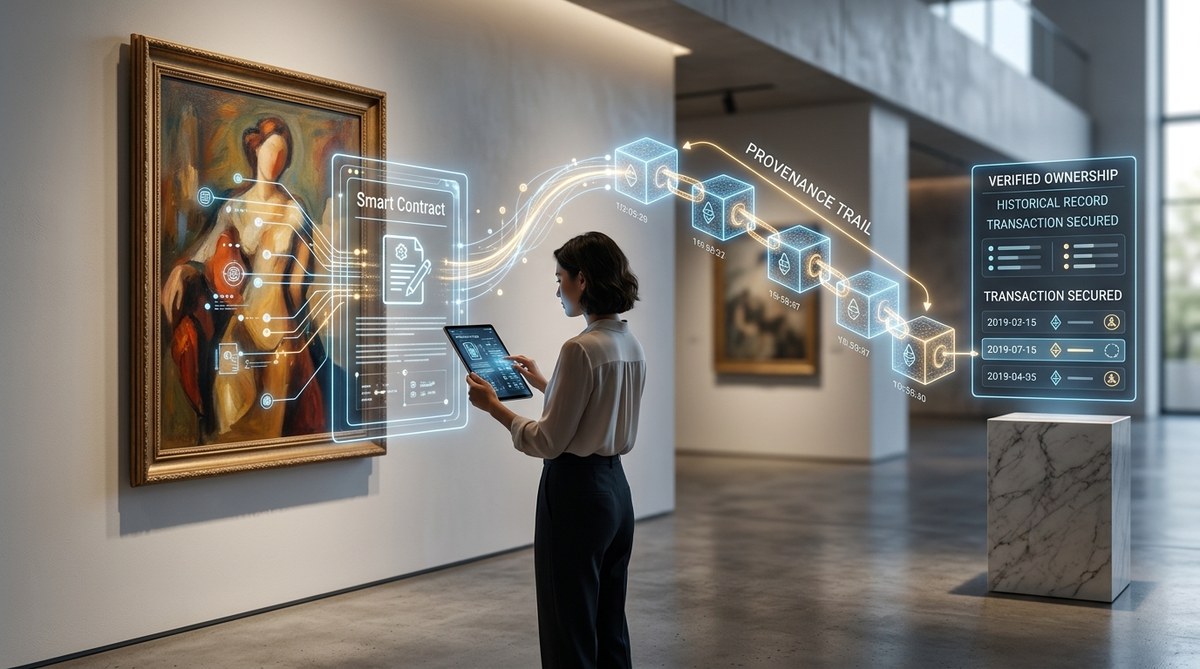
The art world has always struggled with a trust problem. Forged signatures, murky ownership histories, and artists getting cut out of resale profits have plagued the industry for centuries. Now, blockchain technology is rewriting the rules through smart contracts that execute automatically when conditions are met.
Smart contracts art ownership uses blockchain technology to automate authentication, track provenance, and enforce royalty payments without intermediaries. These self-executing programs create transparent ownership records, enable fractional collecting, and ensure artists earn from secondary sales. While challenges exist around legal recognition and technical complexity, smart contracts are fundamentally changing how physical and digital art changes hands.
What smart contracts actually do for art
A smart contract is a program stored on a blockchain that runs when predetermined conditions are met. Think of it as a vending machine. You insert money, select your item, and the machine automatically delivers it. No cashier needed.
In the art world, these contracts handle tasks that previously required lawyers, auction houses, and authentication experts.
When someone buys an artwork tied to a smart contract, the program automatically transfers ownership, updates the provenance record, and can even send a percentage to the original artist. All of this happens in minutes, not weeks.
The contract lives on the blockchain, which means no single person or company controls it. The code executes exactly as written, every time.
This matters because art transactions have traditionally required enormous trust. Buyers trust that certificates are genuine. Sellers trust that payments will clear. Artists trust that galleries will report sales accurately.
Smart contracts replace much of that trust with transparent code that anyone can verify.
How ownership tracking works on the blockchain
Every artwork connected to a smart contract gets a unique digital identity on the blockchain. This identity contains the ownership history, creation date, artist information, and any other data written into the contract.
When ownership changes, the blockchain records the transaction permanently. You cannot erase or modify these records after they are written.
Here is what happens during a typical smart contract art sale:
- The seller lists the artwork with a price and terms coded into the smart contract
- A buyer sends cryptocurrency to the contract address
- The contract verifies the payment amount matches the asking price
- Ownership transfers automatically to the buyer’s wallet address
- The blockchain updates the provenance record with the new owner and transaction details
- If programmed, the contract sends royalty percentages to the artist and any other stakeholders
This process eliminates the need for escrow services, title companies, or payment processors. The contract handles everything based on its programming.
For physical artworks, the smart contract typically connects to a certificate of authenticity or a physical tag embedded in the piece. The blockchain tracks the digital token, which represents ownership of the physical object.
Authentication and provenance verification
Art forgery costs the industry billions annually. Authenticating works, especially from deceased artists, involves subjective opinions from experts who can disagree.
Smart contracts cannot determine if a painting is genuinely a Picasso. But they can create an unbroken chain of custody from the moment of creation.
When an artist mints a new work on the blockchain, the contract records:
- The creator’s verified wallet address
- The exact timestamp of creation
- Initial ownership details
- Any certificates or documentation hashes
Every subsequent sale adds another link to this chain. If someone claims to own a piece but cannot show the blockchain record, red flags go up immediately.
Some platforms now work with artists to create smart contracts at the point of creation. The artist signs the work both physically and digitally, linking the two permanently.
“The blockchain does not replace expert authentication, but it makes fraud exponentially harder. You cannot fake a transaction history that thousands of nodes have verified and stored.”
This approach works especially well for living artists who can personally verify their work and create the initial smart contract. For historical pieces, institutions are beginning to create blockchain records when works pass through their hands, building provenance going forward.
Automated royalties change the economics
Traditional art sales give artists a one-time payment. After that, collectors and dealers capture all appreciation in value. A painting sold for $5,000 might resell years later for $500,000, with the artist receiving nothing.
Smart contracts can change this through programmed royalty payments.
When you code a royalty into a smart contract, every resale automatically sends a percentage back to the artist’s wallet. The seller cannot avoid this payment because the contract will not complete the ownership transfer until all parties receive their programmed amounts.
Common royalty structures include:
- 5-10% to the original artist on all secondary sales
- 2-3% to the platform that hosts the marketplace
- Remainder to the seller after deducting fees
These percentages are set when the contract is created and cannot be changed later without creating a new contract.
For artists, this creates ongoing income from successful works. A piece that changes hands five times over 20 years generates five separate royalty payments.
For collectors, it means slightly higher transaction costs but also demonstrates support for living artists. Some collectors view this as fair compensation for the artist’s role in creating value.
Fractional ownership opens new markets
Buying a Basquiat or a Warhol requires millions of dollars, pricing out most collectors. Smart contracts enable fractional ownership, where multiple people own shares of a single artwork.
The process works like this:
- An artwork gets tokenized into shares (often 100 to 10,000 pieces)
- Each share is represented by a fungible token on the blockchain
- Investors buy shares at a fraction of the total artwork value
- Share prices can fluctuate based on market demand
- Owners can sell shares to others without needing unanimous consent
This model borrows from real estate investment trusts but applies it to art. You might own 0.5% of a rare sculpture, earning your proportional share if it sells or generates revenue through exhibitions.
Some platforms even allow fractional owners to vote on decisions about the artwork, like whether to loan it to a museum or accept a purchase offer.
| Ownership Model | Investment Required | Liquidity | Decision Rights |
|---|---|---|---|
| Full ownership | $10,000 – $10,000,000+ | Low, must sell entire piece | Complete control |
| Fractional shares | $100 – $10,000 | Higher, can sell partial stakes | Proportional voting |
| Gallery membership | $500 – $5,000 | None, no ownership | No ownership rights |
Fractional ownership also introduces price discovery mechanisms that traditional art markets lack. When shares trade frequently, you get real-time market valuations instead of waiting for auction results.
Physical art integration challenges
Digital art like NFTs fits naturally with smart contracts because both exist in the digital realm. Physical artworks create complications.
The smart contract can track ownership perfectly on the blockchain, but someone still needs to physically possess the painting, sculpture, or installation.
Current solutions include:
- Secure storage facilities that only release artworks to verified blockchain owners
- Physical tags with cryptographic chips embedded in the artwork
- Legal contracts that bind physical possession to blockchain ownership
- Insurance and shipping services that verify blockchain records before handling pieces
None of these solutions is perfect. A thief could steal a painting even if they cannot transfer blockchain ownership. The physical and digital worlds remain somewhat separate.
Some collectors solve this by keeping high-value works in professional storage vaults. The artwork never moves, but ownership shares trade freely on the blockchain. You own a percentage of a Monet that sits in a climate-controlled facility in Switzerland.
Other platforms are experimenting with legal frameworks that make blockchain ownership legally binding in traditional courts. If you own the token, you own the artwork under law, regardless of physical possession.
Legal recognition varies by jurisdiction
Smart contracts exist in a legal gray area in many countries. Courts are still determining how to handle disputes when code and traditional law conflict.
Some questions without clear answers:
- Does transferring a token legally transfer ownership of physical art?
- Can artists enforce royalty payments in jurisdictions that do not recognize smart contracts?
- What happens when a smart contract bug causes an unintended transfer?
- How do inheritance laws apply to artwork owned through blockchain wallets?
The United States, European Union, and several Asian countries are developing regulations, but progress is slow and inconsistent.
For now, many platforms layer traditional legal contracts on top of smart contracts. You sign a standard purchase agreement that references the blockchain transaction, giving you protection in both systems.
This dual approach adds costs and complexity but provides legal backup if the smart contract fails or gets disputed.
Setting up a smart contract for your artwork
Artists and galleries can create smart contracts without deep technical knowledge, though the process requires attention to detail.
Here is the basic workflow:
- Choose a blockchain platform (Ethereum, Tezos, and Polygon are popular for art)
- Select a marketplace or minting platform that supports smart contracts
- Prepare high-quality images and metadata about your artwork
- Set your royalty percentages and any special conditions
- Mint the token, which creates the smart contract on the blockchain
- Pay the gas fees (transaction costs) to write the contract
- List the artwork for sale or transfer it to the buyer
Gas fees can range from a few dollars to hundreds depending on network congestion and blockchain choice. Some platforms cover these costs initially and recoup them through sales commissions.
The metadata you include matters enormously. Once written to the blockchain, you cannot easily change it. Include:
- Artwork title and creation date
- Artist name and verified identity
- Medium and dimensions for physical works
- Edition number if applicable
- Any certificates or authentication documents
- Storage location for physical pieces
Some artists include unlockable content that only the owner can access, like high-resolution files, artist notes, or even physical items shipped after purchase.
Common mistakes that cost money
Smart contracts are unforgiving. Code executes exactly as written, even if that is not what you intended.
Mistakes to avoid:
- Setting royalties too high: Percentages above 10% can make your work less attractive to collectors who factor resale costs into their buying decisions
- Choosing the wrong blockchain: High gas fees on Ethereum can make low-priced artworks unprofitable; research alternatives
- Incomplete metadata: Missing information cannot be added later without creating a new contract
- Ignoring legal compliance: Some jurisdictions require specific disclosures or registrations for tokenized assets
- Not testing the contract: Many platforms offer test networks where you can verify everything works before spending real money
- Losing wallet access: If you lose your private keys, you lose access to your artwork and any royalties forever
The permanence of blockchain is both a feature and a risk. Triple-check everything before minting.
Security considerations for collectors
Buying art through smart contracts requires different security practices than traditional purchases.
Your blockchain wallet is your proof of ownership. If someone gains access to your private keys, they can transfer your entire collection without your permission.
Best practices include:
- Using hardware wallets for valuable pieces instead of browser-based wallets
- Never sharing your seed phrase or private keys with anyone
- Verifying contract addresses before sending funds
- Researching platforms and artists before purchasing
- Keeping offline backups of your wallet information in secure locations
- Using multi-signature wallets for high-value collections
Phishing scams are common in the blockchain art world. Attackers create fake websites that look identical to legitimate marketplaces, stealing wallet credentials from unsuspecting users.
Always type URLs directly or use bookmarks. Never click links in emails or messages claiming to be from art platforms.
The environmental debate
Blockchain technology, particularly proof-of-work systems like early Ethereum, consumes enormous amounts of electricity. Critics argue that minting a single NFT can have a carbon footprint equivalent to driving hundreds of miles.
This concern has pushed many art platforms toward more energy-efficient blockchains:
- Proof-of-stake systems use 99% less energy than proof-of-work
- Layer 2 solutions process transactions off the main blockchain, reducing energy use
- Carbon offset programs fund environmental projects to counterbalance blockchain emissions
Ethereum’s transition to proof-of-stake in 2022 dramatically reduced its environmental impact. Tezos and Polygon were designed from the start to be energy-efficient.
For environmentally conscious collectors and artists, choosing the right blockchain matters. Research the energy consumption of any platform before minting or buying.
How galleries are adapting
Traditional galleries face disruption from smart contract platforms that connect artists directly to collectors. Some are fighting the change, while others are integrating blockchain into their business models.
Progressive galleries now:
- Offer both physical and tokenized versions of artworks
- Use blockchain for internal provenance tracking even when not selling NFTs
- Partner with blockchain platforms to reach new collector demographics
- Educate artists about smart contract opportunities and risks
- Create hybrid exhibitions featuring physical and digital works
The gallery’s role is shifting from gatekeeper to curator and educator. Collectors can buy directly from artists, but many still value the curation, authentication, and prestige that established galleries provide.
Some galleries take a percentage of smart contract royalties in exchange for initial promotion and authentication services. This creates ongoing revenue instead of one-time commissions.
Future developments to watch
Smart contract technology for art is still early. Several developments could reshape the landscape:
Interoperability between blockchains would let you buy art on one platform and sell it on another without complex bridging. Currently, most tokens are locked to their original blockchain.
AI authentication tools could analyze artworks and verify them against blockchain records automatically, making forgery even harder.
Augmented reality integration might let collectors display their digital art in physical spaces through AR glasses or projectors, blurring the line between physical and digital collecting.
Decentralized autonomous organizations (DAOs) are forming around art collections, with members voting on acquisitions and sales through smart contracts.
Insurance products specifically designed for blockchain art are emerging, covering both digital and physical risks.
Legal frameworks will eventually catch up, providing clearer rules for disputes, inheritance, and cross-border transactions.
The technology improves rapidly, but adoption depends on solving real problems for artists and collectors, not just chasing trends.
Why this matters for your collection strategy
Smart contracts art ownership is not replacing traditional collecting. It is creating a parallel system with different strengths and weaknesses.
For digital art, blockchain provides the scarcity and provenance that digital files naturally lack. For physical art, it adds transparency and automation to processes that have not changed much in centuries.
Whether you are an artist considering tokenizing your work, a collector evaluating blockchain art, or a gallery owner adapting to new technology, understanding smart contracts is becoming essential.
The technology is not perfect. Legal questions remain. Environmental concerns persist. Technical barriers exclude some participants.
But the core value proposition is compelling: transparent ownership, automated payments, permanent provenance, and new ways to invest in and support artists.
Start small. Buy a modestly priced piece on a reputable platform. Mint a single artwork if you are an artist. Experience how the technology works before committing significant resources.
The art world has always evolved with technology, from oil paints to photography to video installations. Smart contracts are the next chapter in that evolution, and understanding them now positions you for whatever comes next.
