What Happens When Blockchain Networks Merge? Understanding the Ethereum Merge’s Impact on Digital Art

When Ethereum completed its transition from Proof of Work to Proof of Stake in September 2022, the entire NFT ecosystem held its breath. Collectors worried about losing their digital art. Artists questioned whether their smart contracts would survive. And everyone wondered what would happen to the billions of dollars locked in NFT marketplaces.
The Ethereum Merge successfully transitioned the network to Proof of Stake without disrupting NFT ownership or metadata. Your digital art remained intact, but the upgrade brought lower energy consumption, changed validator economics, and set the stage for future scalability improvements that affect transaction costs and network security for all collectors and artists.
What Actually Happened During the Merge
The Merge replaced Ethereum’s mining system with a staking model. Miners who solved complex puzzles to validate transactions stepped aside. Validators who lock up 32 ETH now secure the network instead.
This technical shift reduced Ethereum’s energy consumption by 99.95%. That number matters for NFT collectors because environmental criticism had become one of the loudest arguments against digital art on the blockchain.
Your NFTs did not move, disappear, or change hands. The transition happened at the protocol level, not the application layer where NFTs live. Think of it like replacing the engine in a car while keeping all the passengers safely in their seats.
Smart contracts continued executing exactly as programmed. The smart contracts are revolutionizing art ownership and provenance) mechanics that define ownership, royalties, and transfers remained identical before and after the Merge.
How NFT Ownership Stayed Protected
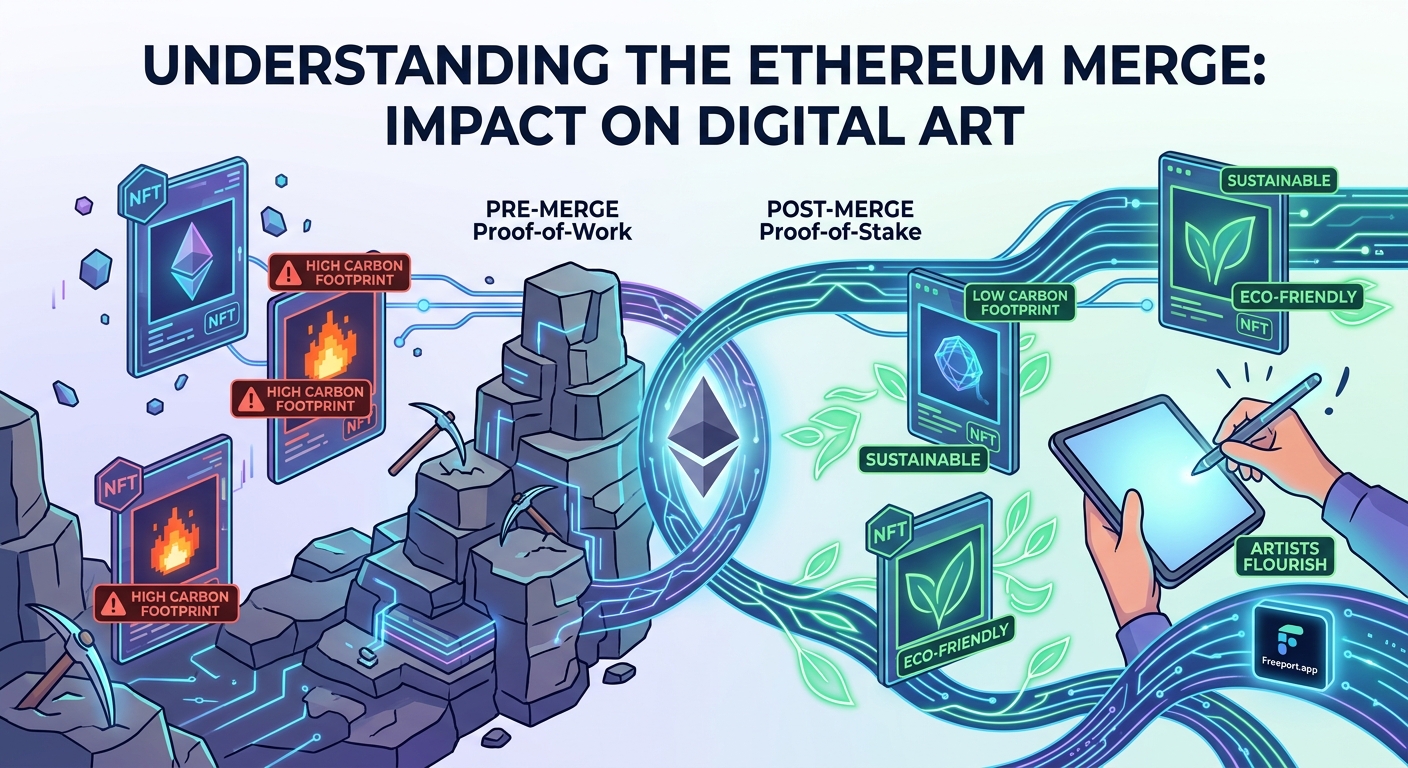
Every NFT exists as a token on the Ethereum blockchain. That token points to metadata, usually stored on IPFS or Arweave. The Merge changed the consensus mechanism but left the data structure untouched.
Your wallet address still controls the same tokens. Your private keys still grant access to those assets. The proof of ownership recorded on the blockchain carried over seamlessly to the new Proof of Stake system.
Here’s what stayed the same:
- Token IDs and contract addresses
- Metadata links and file locations
- Transaction history and provenance records
- Royalty structures embedded in smart contracts
- Marketplace listings and floor prices
The transition happened at block 15537393. Before that block, miners validated transactions. After it, validators took over. But the ledger itself maintained perfect continuity.
Gas Fees and Transaction Costs After the Merge
Many collectors expected the Merge to dramatically lower gas fees. That didn’t happen immediately because the upgrade focused on consensus, not scalability.
Gas fees depend on network congestion and block space. The Merge didn’t increase the number of transactions Ethereum can process per second. That improvement requires additional upgrades like sharding, which remain in development.
However, the Merge did create conditions for future fee reductions. The switch to Proof of Stake made the network more predictable and stable. This stability helps 2 solutions) operate more efficiently.
| Factor | Before Merge | After Merge |
|---|---|---|
| Energy consumption | High (mining) | 99.95% lower (staking) |
| Block time | ~13 seconds | ~12 seconds (slightly faster) |
| Transaction throughput | ~15 TPS | ~15 TPS (unchanged) |
| Gas fee structure | Variable | Variable (no direct change) |
| Network security model | Proof of Work | Proof of Stake |
Collectors should understand that lower fees will come from Layer 2 rollups and future Ethereum upgrades, not from the Merge itself. The Merge laid the groundwork but didn’t solve congestion on its own.
Smart Contract Continuity and Artist Royalties
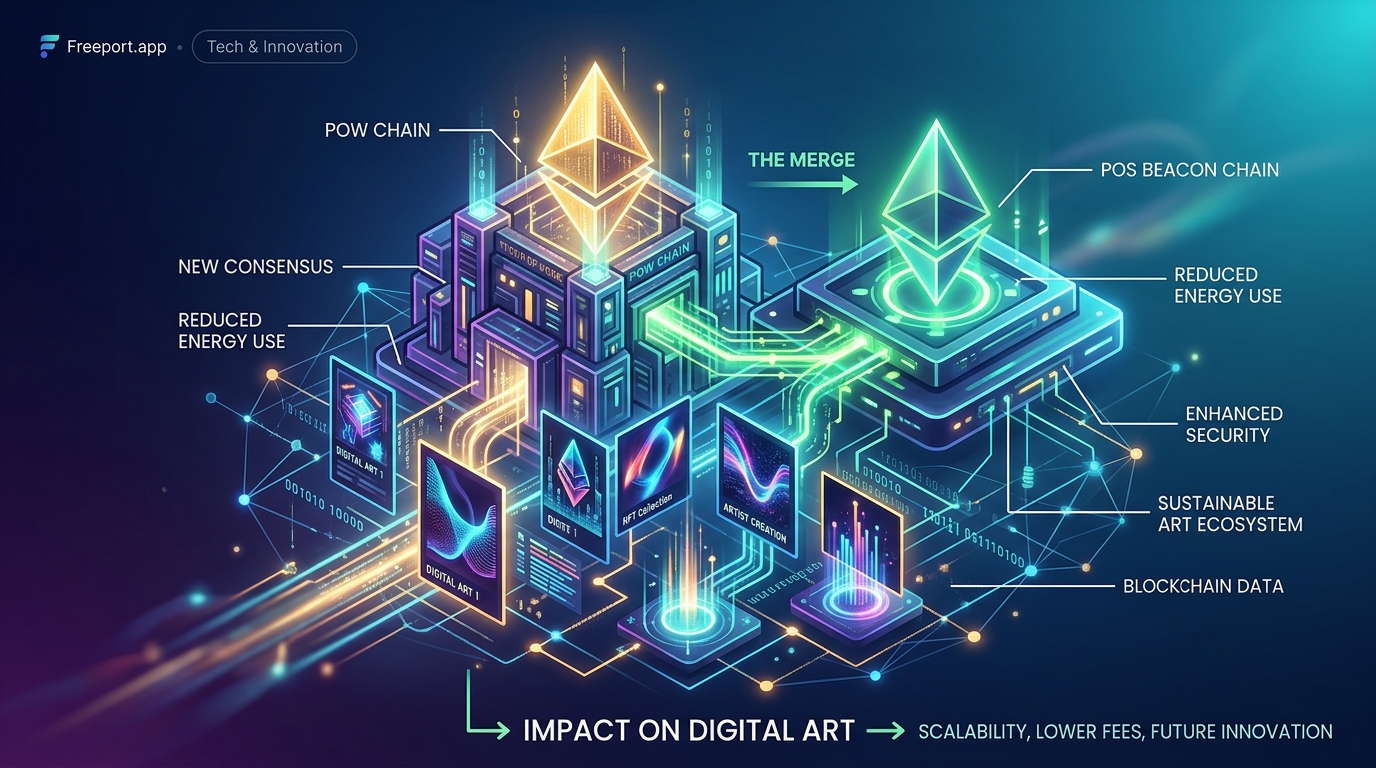
Artists who minted NFTs before the Merge kept their royalty structures intact. The code governing secondary sales continued executing without interruption.
This matters because contract royalties) represent a major innovation in digital art. Creators earn a percentage every time their work resells, programmed directly into the blockchain.
The Merge proved that Ethereum can undergo massive technical changes without breaking existing applications. This resilience gives collectors confidence that their investments won’t vanish during future network upgrades.
The Merge demonstrated that a blockchain can evolve its core infrastructure while preserving every application and asset built on top of it. This precedent matters more than any single technical improvement.
Artists gained an additional benefit: reduced environmental criticism. The 99.95% energy reduction removed one of the primary objections to NFT creation and collecting. Museums, galleries, and institutional collectors became more comfortable blockchain art collections) after the transition.
Security Changes for NFT Holders
Proof of Stake introduced a different security model. Instead of computational power protecting the network, economic incentives now do the work.
Validators must stake 32 ETH to participate. If they behave dishonestly, they lose their stake through a process called slashing. This creates a strong financial disincentive for attacks.
For NFT collectors, this shift means:
- Economic security replaced computational security: Attacking the network now requires buying massive amounts of ETH rather than building mining farms.
- Validator decentralization increased: More people can afford to stake 32 ETH than could afford industrial mining operations.
- Network finality improved: Transactions become irreversible faster under Proof of Stake, reducing the risk of chain reorganizations affecting recent NFT purchases.
The security model change didn’t require collectors to take any action. Your and security practices) for high-value digital assets remain the same. Hardware wallets, seed phrase protection, and careful transaction verification still form the foundation of NFT security.
Environmental Impact and Market Perception
The energy reduction transformed how mainstream media and institutions discuss NFTs. Before the Merge, environmental concerns dominated many conversations about digital art.
A single Ethereum transaction under Proof of Work consumed as much electricity as an average U.S. household uses in a week. Under Proof of Stake, that same transaction uses less energy than watching an hour of Netflix.
This shift affected several areas:
- Corporate collectors felt more comfortable entering the NFT space
- Artists faced less criticism for minting on Ethereum
- Environmental organizations softened their stance on blockchain art
- Traditional galleries reduced hesitation about representing digital artists
The perception change matters as much as the technical improvement. artists) now face fewer barriers when exhibiting in traditional art spaces or seeking institutional recognition.
What the Merge Didn’t Change
Understanding what stayed the same helps clarify common misconceptions about the upgrade.
The Merge did not:
- Make Ethereum transactions instant
- Eliminate gas fees or make them negligible
- Change how you mint, buy, or sell NFTs
- Alter the appearance or metadata of existing tokens
- Require collectors to update wallets or move assets
- Affect NFTs on other blockchains like Solana or Tezos
- Introduce new features for smart contracts
- Change how royalties function on marketplaces
Many collectors expected dramatic immediate changes. The reality was more subtle. The Merge created a foundation for future improvements rather than delivering instant transformation.
Preparing for Future Ethereum Upgrades
The Merge represents one milestone in Ethereum’s multi-year roadmap. Future upgrades will address scalability, reduce fees, and improve user experience.
Understanding this timeline helps collectors make informed decisions:
- Monitor sharding development: This upgrade will dramatically increase transaction capacity and lower fees.
- Watch Layer 2 adoption: Solutions like Arbitrum and Optimism already offer lower-cost alternatives for NFT transactions.
- Stay informed about EIP proposals: Ethereum Improvement Proposals sometimes affect how NFTs function or how royalties work.
The successful Merge proved that Ethereum can execute complex upgrades without disrupting existing assets. This track record reduces anxiety about future changes and increases confidence in long-term holding strategies.
Collectors should focus on valuable digital art collections) based on artistic merit and community strength rather than worrying about technical transitions. The infrastructure has proven resilient.
Validator Economics and NFT Market Dynamics
Proof of Stake changed who profits from securing Ethereum. Miners who sold ETH regularly to cover electricity costs gave way to validators who earn staking rewards.
This shift affects NFT markets in subtle ways. Validators tend to hold ETH rather than immediately selling it. This reduced selling pressure can support higher ETH prices, which correlates with increased NFT market activity.
Higher ETH prices make NFTs priced in ETH more expensive for new collectors. But they also increase the dollar value of existing collections, creating a wealth effect that can drive more collecting activity.
The relationship between staking yields and NFT collecting also matters. When staking returns are high, some capital flows away from speculative assets like NFTs. When returns are modest, collectors may seek higher returns through digital collection categories).
Metadata and Storage Considerations
The Merge didn’t change where NFT metadata lives, but it did increase awareness about storage practices. Collectors realized that blockchain transitions can happen smoothly, but they also started asking harder questions about NFT preservation).
Most NFTs store their actual image, video, or audio files off-chain. The blockchain only contains a link to that content. This design makes sense because storing large files directly on Ethereum costs too much.
But it creates a dependency. If the storage service disappears, your NFT token remains on the blockchain, but the art it points to vanishes. This concern existed before the Merge and persists after it.
Collectors should verify:
- Where their NFT metadata lives (IPFS, Arweave, centralized server)
- Whether the project uses permanent storage solutions
- If the contract includes backup links or fallback options
- How the project plans to maintain access long-term
The Merge’s success highlighted that blockchain infrastructure can evolve reliably. This makes the contrast with fragile storage solutions more apparent. Smart collectors now pay more attention to happens when platforms shut down).
Market Reaction and Price Movements
NFT floor prices didn’t show a consistent pattern immediately after the Merge. Some collections saw increased activity as environmental concerns faded. Others continued following broader crypto market trends.
The most significant market impact came from renewed confidence in Ethereum’s long-term viability. Major collections like CryptoPunks and Art Blocks, which exist exclusively on Ethereum, benefited from reduced platform risk.
Collectors who worried that Ethereum might fail during the transition found reassurance. This reduced one source of uncertainty that had hung over the market since the Merge was first announced years earlier.
NFT collections) demonstrated resilience through the upgrade. Their floor prices remained stable or increased, confirming that established projects with strong communities can weather major technical transitions.
Authentication and Verification After the Transition
The Merge didn’t change how collectors verify NFT authenticity, but it did prove that verification methods remain reliable through major network changes.
practices) that worked before the Merge work identically afterward:
- Checking contract addresses against official sources
- Verifying the creator’s wallet address
- Examining transaction history and provenance
- Confirming metadata matches the advertised artwork
- Using blockchain explorers to trace ownership
The continuity of these verification methods reinforces that NFT ownership exists independently of the consensus mechanism. Your ability to prove you own a specific token doesn’t depend on whether the network uses Proof of Work or Proof of Stake.
Cross-Chain Implications
Ethereum’s successful transition put pressure on other blockchain networks. Collectors started asking why alternatives still use energy-intensive mining or why they can’t execute similar upgrades.
Some artists and collectors who had moved to alternative chains for environmental reasons reconsidered Ethereum. The network’s combination of security, decentralization, and now energy efficiency became more compelling.
This doesn’t mean Ethereum recaptured all market share. Networks like Tezos, which was always Proof of Stake, maintained their communities. Solana offered different technical trade-offs. But Ethereum’s environmental objection disappeared as a primary reason to choose alternatives.
Looking Ahead for Digital Art Collectors
The Merge proved that blockchain infrastructure can evolve without breaking the applications built on top. This precedent matters for long-term collecting strategies.
Collectors can invest in digital art with greater confidence that technical upgrades won’t destroy their holdings. The fear that a botched transition might erase NFTs or make them inaccessible proved unfounded.
Future upgrades will bring actual improvements to the collecting experience. Lower fees through sharding. Faster transactions through optimizations. Better user experiences through wallet improvements. The Merge laid groundwork for all of these enhancements.
Artists gained validation that creating on Ethereum won’t permanently tie their work to environmentally destructive technology. This removed a significant barrier to mainstream acceptance and institutional recognition.
The upgrade also demonstrated the importance of choosing established platforms with strong technical teams. Ethereum’s ability to execute a years-long roadmap and deliver a complex upgrade successfully sets a high bar for competing networks.
Why This Technical Transition Matters for Your Collection
The Merge wasn’t just a technical achievement. It was a proof point that blockchain-based digital art can evolve and improve while preserving everything collectors value about ownership and provenance.
Your NFTs survived the most significant infrastructure change in Ethereum’s history. The smart contracts that define ownership continued working. The metadata that makes your art viewable remained accessible. The transaction history that proves authenticity carried forward intact.
This resilience should inform how you think about collecting digital art. Choose platforms with strong technical foundations. Support projects that use permanent storage solutions. Build collections based on artistic merit and community strength rather than short-term hype.
The environmental criticism that once dominated NFT discussions has faded. Museums, galleries, and institutional collectors now engage with blockchain art more openly. Artists face fewer barriers when exhibiting or seeking recognition for their digital work.
Understanding how the Merge affected your collection helps you make better decisions going forward. You know that major upgrades can happen smoothly. You’ve seen that ownership rights survive technical transitions. And you understand that Ethereum continues evolving to serve collectors and artists better over time.