Are Generative Art Collections a Safer Bet Than Profile Picture NFTs in 2026?
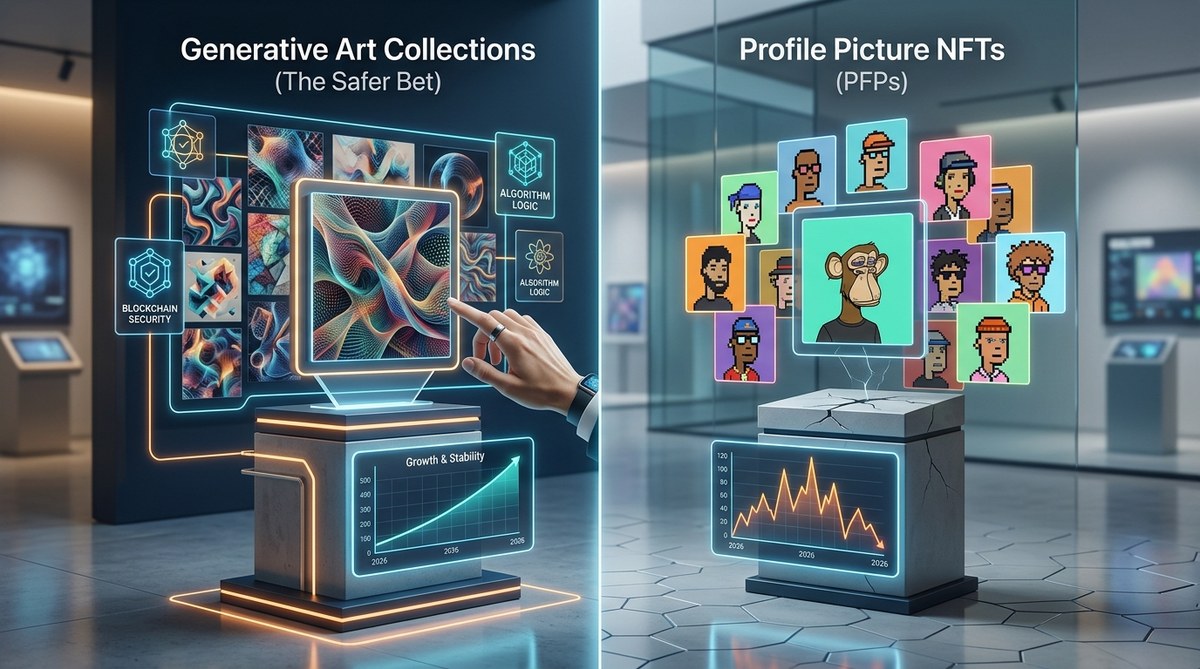
If you have been following the NFT space for a while, you have seen two distinct categories rise to the top: generative art collections and profile picture NFTs (PFPs). Both have made headlines. Both have made people money. But in 2026, the question every collector asks is which one offers a safer bet for your capital. The answer is not as simple as picking one side. It depends on how you define safety and what kind of risk you are willing to hold.
Generative art collections often hold value better during downturns because their worth is tied to artist reputation, algorithmic uniqueness, and institutional demand. Profile picture NFTs rely heavily on community hype and brand momentum, which can evaporate overnight. In 2026, the safer long term strategy leans toward generative art, but PFPs still offer opportunities for those who understand timing and exit points.
What Makes Generative Art Different
Generative art is created by an algorithm that produces unique outputs based on a set of rules. Think of Art Blocks, Fidenza, or the latest on chain pioneers. Each piece is one of a kind, but the collection as a whole shares a coherent visual language. Collectors buy these because they appreciate the code, the aesthetic, and the scarcity that comes from the minting process. The value does not depend on a discord server staying active.
These collections often land in museum exhibitions and attract institutional buyers. When a foundation or a museum acquires a piece from a generative set, it signals to the market that the work has cultural significance. That kind of validation does not fade when a bull run ends. It provides a floor that is more resilient than hype.
Generative art also has a strong secondary market on platforms like SuperRare, Foundation, and specialized marketplaces. The liquidity might not be as high as a top PFP project, but the trading volume is less prone to rug pulls because the focus is on the art itself, not on promised utility.
The PFP Reality in 2026
Profile picture NFTs like CryptoPunks, Bored Ape Yacht Club, and their many successors served a different purpose. They were identity markers, status symbols, and entry tickets to communities. In 2022 and 2023, that model worked. By 2026, the landscape has shifted. Many PFP projects that launched during the frenzy have zero volume. Even blue chip PFPs have seen floor prices drop 60 to 80 percent from their peaks.
The main risk with PFPs is that their value is almost entirely social. If the founders go quiet, if the roadmap stalls, or if the community loses interest, the collection becomes a ghost town. It is hard to sell something when nobody is looking for it. Generative art collections do not have that same vulnerability because the art stands alone.
That said, some PFPs have survived by evolving into brands. Bored Ape Yacht Club still has licensing deals and events. But those are the exceptions. For every BAYC, there are hundreds of PFPs that are now worthless.
Generative Art vs Profile Picture NFTs: A Comparison
| Aspect | Generative Art Collections | Profile Picture NFTs |
|---|---|---|
| Primary value driver | Artistic merit, algorithmic rarity, provenance | Community hype, brand status, roadmap utility |
| Typical floor price stability | Moderate to high; slower to crash | Highly volatile; can drop 90%+ |
| Liquidity during bear markets | Still trades, albeit at lower volumes | Often dries up completely |
| Institutional interest | High; museums, funds, and galleries | Low; mostly retail speculation |
| Artist reputation impact | Direct and lasting | Rarely matters; team/community focus |
| Long term holding suitability | Strong, if the artist maintains relevance | Weak, unless the brand evolves |
How to Evaluate Any Generative Art Collection
If you want to buy generative art with safety in mind, follow this numbered process.
- Research the artist’s history and reputation. A generative artist who has been creating for years and has a consistent body of work is less likely to disappear. Check their exhibition record, sales history, and social media presence.
- Assess the algorithm’s uniqueness. Collections that rely on simple shape rotations or color swaps are less interesting. Look for projects where the code produces genuinely surprising results.
- Study the on chain provenance. Use a block explorer to see if the contract has been verified and if the metadata is stored on chain or on IPFS. Collections that store everything on chain are safer if a marketplace goes offline.
- Check secondary market depth. Look at the number of active listings, daily volume, and how many unique holders there are. A collection with many holders and steady trade is more liquid.
- Evaluate the collection’s place in art history. Is it part of a recognized movement? Did it pioneer a new technique? Projects that shape the medium tend to hold value longer.
Risk Factors to Keep on Your Radar
Even generative art has risks. Here are the main ones to watch.
- Artist reputation risk: If the artist becomes controversial or stops creating, the collection can lose value.
- Platform risk: If the marketplace where you bought disappears, you need a way to transfer or sell elsewhere. It helps to use self custodial wallets.
- Copycat risk: Anyone can fork an algorithm. True generative value comes from the artist’s name and the original mint.
- Market cyclicality: No asset class is immune to downturns. Expect paper losses during a crypto winter.
“Generative art is not immune to market cycles, but its floor tends to be higher because the buyer base includes serious collectors who hold through volatility. PFP buyers are often traders who exit at the first sign of trouble. That difference matters when you are choosing where to park capital for years, not weeks.” — Elena Voss, curator of digital art at a private foundation.
Liquidity and Exit Strategies
One of the biggest concerns with generative art is that it can be harder to sell compared to a widely traded PFP. A Bored Ape can be listed on multiple marketplaces and attract bids within minutes. A generative piece from a lesser known artist might sit for weeks.
But that trade off comes with a benefit: when you do sell, you are less likely to be selling into a panic. PFP markets can collapse in hours because everybody rushes to the exit. Generative art collectors are more patient. They understand that finding the right buyer takes time.
If you need liquidity, consider sticking to the top tier generative collections. Think of names like Tyler Hobbs, Dmitri Cherniak, or Snowfro. These artists have established secondary markets that function even during bearish periods. You can also use fractionalization platforms to sell parts of a piece if you need cash.
The Institutional Shift
In 2026, one of the biggest changes is the entry of institutional money into generative art. Museums are building digital art collections. Investment funds are allocating small percentages to blue chip generative pieces. This is not happening with PFPs.
Institutions care about provenance, artist pedigree, and historical significance. Generative art checks those boxes. PFPs do not, because they are seen as consumer products rather than fine art. When institutions start buying, they provide a stable demand base that reduces volatility.
If you want to align with the institutional trend, focus on collections that have been acquired by notable museums or that appear in major exhibitions. That external validation acts like a safety net.
What Happens When a Platform Shuts Down
Another safety consideration is platform independence. Generative art that is fully on chain or stored on IPFS can survive a marketplace closure. You can still access your token, view the artwork, and trade it on another platform.
PFPs often rely on centralized servers for their images. If the hosting goes down, your PFP might become a broken link. Always check where the metadata is stored before buying. Collections that use decentralized storage are safer in the long run.
Building a Smarter Strategy for 2026
The safest approach is not to bet entirely on one category. You can build a portfolio that mixes generative art for stability with a small allocation of blue chip PFPs for upside potential. Just make sure you understand the difference between a buy and hold strategy versus a flip.
Generative art rewards patience and research. PFPs reward timing and community insight. If you are risk averse, lean into algorithmic collections with proven artists. If you have a high tolerance, take calculated punts on emerging PFP projects only if you are early and you exit before the hype fades.
No matter which path you choose, always store your assets in a wallet you control. Use hardware wallets for high value pieces. And never invest money you cannot afford to lose, even in the safest looking collection.
The market in 2026 is more mature than it was a few years ago. The noise has died down. What remains are the projects that actually have value. Your job as a collector is to tell the difference before the crowd does. Start with the art. Let the hype come second.