Gas Fees Explained: What Digital Art Buyers Actually Pay on Different Blockchains
You’re about to buy your first piece of blockchain art. You’ve found the perfect piece, checked the artist’s credentials, and you’re ready to click purchase. Then you see the transaction cost: $47 in gas fees for a $200 artwork. Suddenly, your purchase just became 23% more expensive, and you’re wondering what you’re actually paying for.
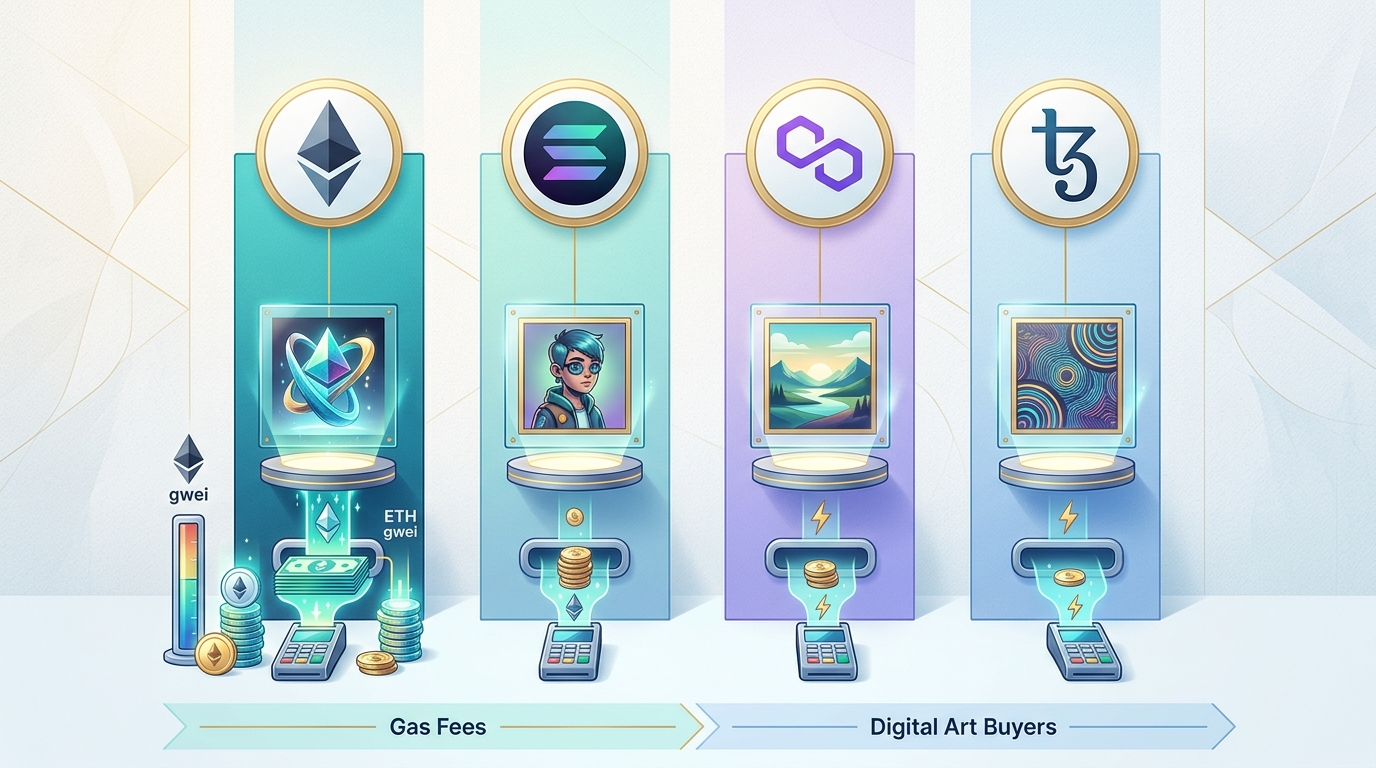
Gas fees are network processing costs that vary dramatically by blockchain, time of day, and transaction complexity. Ethereum typically charges $15 to $150 per transaction, while alternatives like Solana average under $0.01 and Tezos stays below $0.50. Understanding these costs and timing your purchases strategically can save hundreds of dollars annually for active collectors building their digital art portfolios.
What Gas Fees Actually Are
Gas fees pay for computational power on blockchain networks.
Every transaction requires validators or miners to process your request, verify its legitimacy, and permanently record it on the blockchain. These network participants don’t work for free. They need compensation for the electricity, hardware, and time they invest in maintaining the network.
Think of gas fees like shipping costs for physical art. The price varies based on package weight (transaction complexity), delivery speed (how fast you want confirmation), and current demand (network congestion). A simple NFT purchase might cost less than minting a complex generative artwork that requires multiple contract interactions.
The term “gas” originated with Ethereum, drawing an analogy to fuel that powers a car. Your transaction is the vehicle, and gas is what makes it move through the network.
Different blockchains measure gas differently. Ethereum uses “gwei” (one billionth of an ETH). Solana measures in “lamports.” Tezos uses “mutez.” But they all serve the same purpose: compensating network participants for processing your transaction.
Breaking Down Transaction Costs Across Major Blockchains
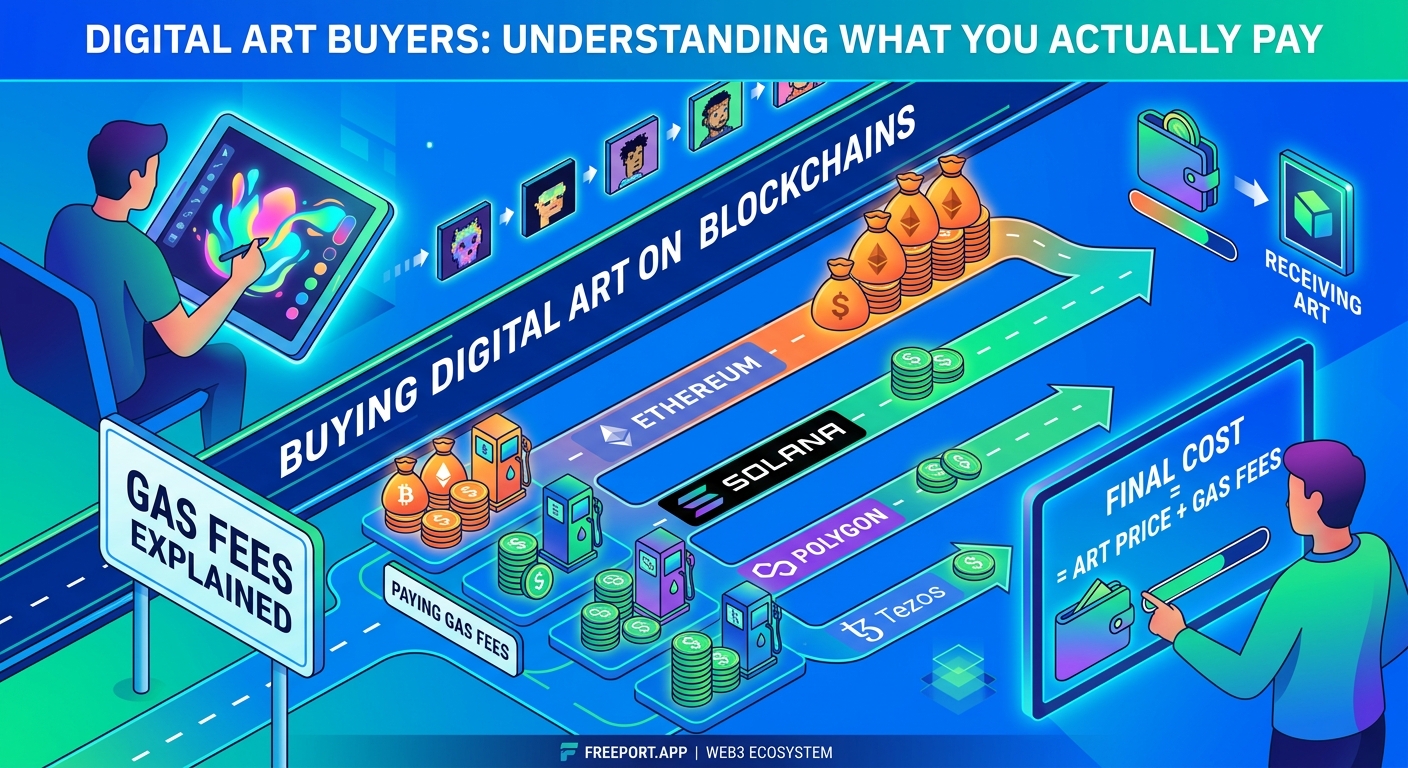
Here’s what you’ll actually pay on different networks:
| Blockchain | Average Gas Fee | Peak Hour Fee | Best Time to Transact | Transaction Speed |
|---|---|---|---|---|
| Ethereum | $15 to $45 | $80 to $150 | 2am to 6am UTC | 15 seconds to 5 minutes |
| Polygon | $0.01 to $0.10 | $0.50 to $2 | Consistent all day | 2 to 5 seconds |
| Solana | $0.00025 | $0.01 | Consistent all day | Under 1 second |
| Tezos | $0.10 to $0.30 | $0.50 to $1 | Consistent all day | 30 seconds to 1 minute |
| Arbitrum | $0.50 to $2 | $3 to $8 | Weekday mornings | 1 to 2 minutes |
| Base | $0.10 to $0.50 | $1 to $3 | Early mornings | 2 to 5 seconds |
Ethereum remains the most expensive option, but it also hosts the largest selection of established artists and blue chip collections. You’re paying for network effects and prestige, not just transaction processing.
Layer 2 solutions like Polygon and Arbitrum offer dramatically lower fees while maintaining compatibility with Ethereum’s ecosystem. Many artists now migrate to these networks specifically to make their work more accessible to collectors.
Solana and Tezos built low fees into their core architecture from day one. These networks sacrifice some decentralization for speed and affordability, making them popular with emerging artists and collectors building large portfolios.
How to Calculate Your True Purchase Cost
Gas fees represent just one component of your total acquisition cost.
Follow these steps to understand what you’ll actually pay:
- Check the artwork’s list price in the platform’s native currency (ETH, SOL, XTZ, etc.).
- Add the current gas fee estimate shown in your wallet before confirming.
- Include any platform fees (typically 2.5% to 10% of the sale price).
- Factor in currency conversion fees if you’re buying crypto with fiat.
- Consider potential royalty obligations if you plan to resell.
A $500 NFT on Ethereum during peak hours might actually cost you:
- List price: $500
- Platform fee (5%): $25
- Gas fee: $65
- Credit card to crypto conversion (3%): $15
- Total: $605
That’s 21% above the displayed price. For collectors making multiple purchases, these costs compound rapidly.
“I spent three months buying art on Ethereum before I realized I’d paid over $1,200 in gas fees alone. Switching to Polygon for smaller acquisitions cut my transaction costs by 99%, letting me support more emerging artists with the same budget.” — Digital art collector since 2021
Why Gas Fees Fluctuate So Dramatically
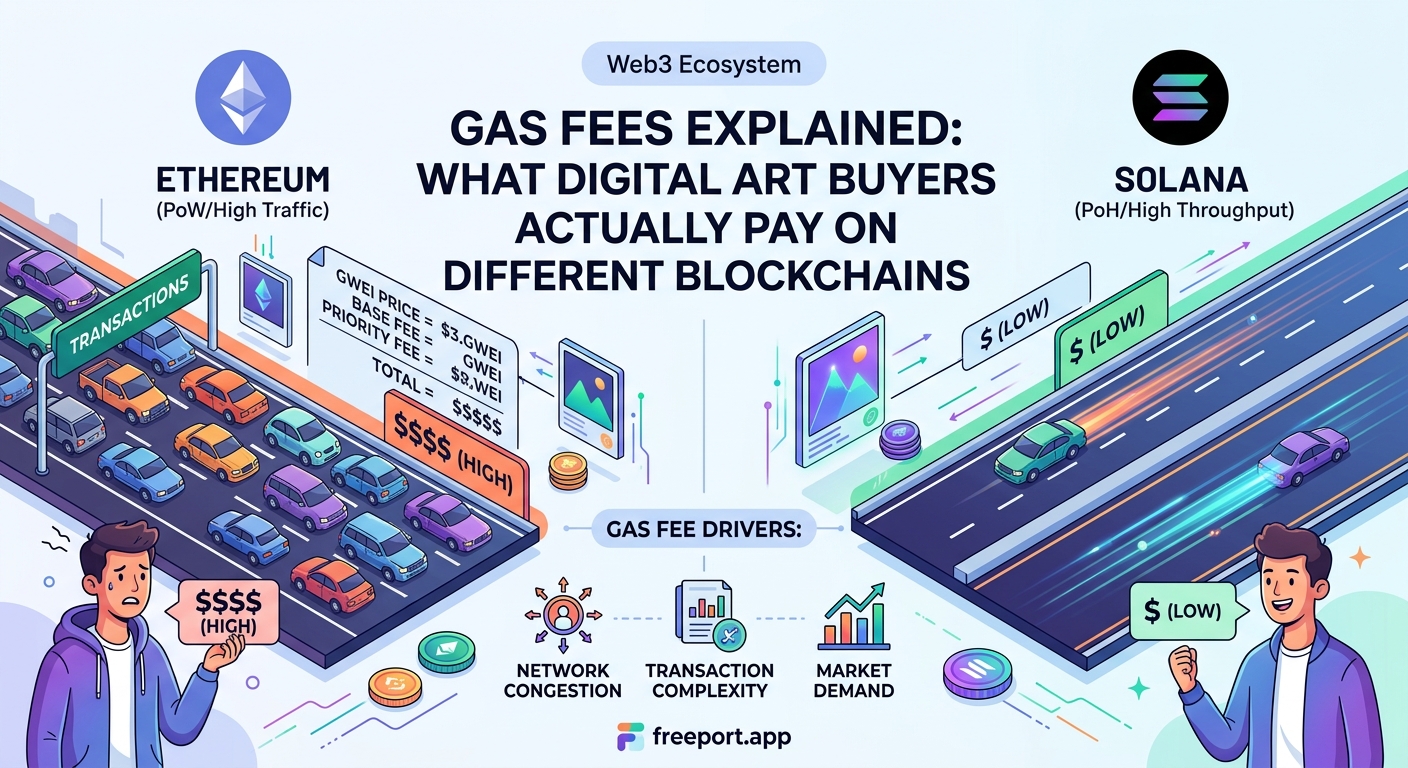
Network congestion drives price volatility.
Blockchain networks process a limited number of transactions per second. Ethereum handles roughly 15 to 30. Solana manages around 3,000. When demand exceeds capacity, users compete by offering higher fees to validators.
Picture a highway during rush hour. Everyone wants to use the same road at the same time. Some drivers are willing to pay toll lane premiums to move faster. Blockchain works identically, except the “toll” is your gas fee and the “fast lane” is priority processing.
Major NFT drops create massive congestion spikes. When a highly anticipated collection launches, thousands of collectors simultaneously attempt purchases. Gas fees can jump from $20 to $300 in minutes.
Time zones matter more than you’d expect. Ethereum fees typically peak between 2pm and 10pm Eastern Time, when both US and European markets are active. Asian trading hours (7pm to 3am Eastern) see moderate activity. The sweet spot for low fees runs from 2am to 8am Eastern, when global activity reaches its minimum.
Network upgrades and protocol changes also impact fees. Ethereum’s transition to proof of stake reduced but didn’t eliminate fee volatility. Layer 2 solutions continue evolving, gradually making transactions more affordable.
Strategies to Minimize Your Transaction Costs
Smart timing saves serious money.
- Wait for low congestion periods before making non-urgent purchases
- Use gas tracking tools like Etherscan’s Gas Tracker or Blocknative to monitor real-time prices
- Set custom gas limits in your wallet instead of accepting default “fast” options
- Batch multiple purchases into single transactions when platforms support it
- Consider alternative blockchains for works by emerging artists where Ethereum provenance matters less
Many collectors maintain wallets on multiple chains. They buy established blue chip pieces on Ethereum despite higher fees, while acquiring experimental work on Solana or Tezos where transaction costs barely register.
Platform choice matters significantly. Some marketplaces absorb gas fees for buyers, passing costs to sellers or building them into listing prices. Others charge buyers directly. Always check a platform’s fee structure before committing to a purchase.
Lazy minting has become increasingly common. This approach delays blockchain recording until the first sale occurs, eliminating upfront minting costs for artists. Buyers pay gas fees only once, during their purchase transaction, rather than the artist paying to mint and the buyer paying to purchase.
Hidden Costs Beyond Basic Gas Fees
Transaction fees tell an incomplete story.
When you mint your own artwork, you’ll encounter additional costs:
- Contract deployment fees (one-time, $50 to $500 on Ethereum)
- Metadata storage costs if using decentralized systems
- Approval transactions before your first sale (typically $5 to $30)
- Listing fees on some platforms
- Transfer fees when moving work between wallets
Collectors often forget about the gas fees required to eventually sell or transfer their acquisitions. That $200 artwork might cost another $40 in gas when you decide to list it for resale three years later.
Smart contract interactions sometimes require multiple transactions. Accepting an offer, transferring ownership, and updating metadata might each trigger separate gas charges. A complex sale could involve three or four fee-generating steps.
Currency volatility adds another layer of uncertainty. Gas fees are denominated in the blockchain’s native token. If you buy when ETH costs $2,000 but sell when it hits $4,000, your gas fees have effectively doubled in dollar terms, even if the gwei amount stayed constant.
Comparing Total Cost of Ownership Across Platforms
Let’s examine realistic scenarios for building a 20-piece collection over six months:
Ethereum mainnet approach:
* 20 purchases at average $30 gas each: $600
* Platform fees at 5% on $10,000 total purchases: $500
* One resale attempt: $45
* Total fees: $1,145
Polygon alternative:
* 20 purchases at average $0.05 gas each: $1
* Platform fees at 5% on $10,000 total purchases: $500
* One resale attempt: $0.10
* Total fees: $501
Mixed strategy (10 Ethereum, 10 Polygon):
* 10 Ethereum purchases at $30 gas: $300
* 10 Polygon purchases at $0.05 gas: $0.50
* Platform fees at 5% on $10,000 total: $500
* One resale on each chain: $45.10
* Total fees: $845.60
The mixed approach lets you acquire prestigious Ethereum pieces while keeping overall costs manageable. Many experienced collectors adopt this strategy, reserving Ethereum for works they consider long-term holdings and using cheaper chains for experimental acquisitions.
When Higher Gas Fees Make Sense
Sometimes paying premium transaction costs is the right choice.
Ethereum’s higher fees come with tangible benefits. The network offers superior security through its massive validator network. Provenance matters deeply in the art world, and Ethereum hosts the most comprehensive transaction history.
Museums and institutions overwhelmingly prefer Ethereum for their blockchain acquisitions. If you’re collecting with an eye toward long-term value and institutional recognition, the extra gas cost represents insurance against future compatibility or prestige issues.
Rare drops from established artists justify higher fees. Missing a limited edition from an artist you’ve followed for years because you wanted to save $50 in gas makes little sense if the piece appreciates significantly.
Time-sensitive opportunities don’t wait for optimal gas prices. If you spot an undervalued work that’s likely to sell within hours, paying current rates beats missing the acquisition entirely.
Tools and Resources for Tracking Gas Prices
Several platforms help you time transactions strategically:
- Etherscan Gas Tracker: Real-time gwei prices with historical charts
- Blocknative Gas Estimator: Predictive modeling for upcoming fee trends
- Polygon Gas Station: Network-specific tracking for Layer 2 transactions
- Solana Beach: Comprehensive Solana network statistics including fee averages
- TzStats: Tezos blockchain explorer with fee analytics
Most modern wallets now include built-in gas estimation. MetaMask, Phantom, and Temple all show current network conditions and let you adjust your willingness to pay for faster processing.
Setting up price alerts helps you catch optimal windows. Some collectors use services that notify them when Ethereum gas drops below specific thresholds, then batch their planned purchases during those periods.
Making Gas Fees Work for Your Collection Strategy
Understanding transaction costs should inform but not dominate your collecting decisions.
Gas fees represent a real expense, but they’re one factor among many. Artist reputation, artwork quality, historical significance, and personal connection all matter more than saving $20 on a transaction fee.
Build a collection strategy that accounts for costs without letting them constrain your vision. If you’re drawn to emerging artists working on expensive chains, budget accordingly. If you’re exploring new aesthetics and want to take risks on unknown creators, cheaper networks let you experiment more freely.
The blockchain art market continues maturing. Fee structures evolve, new Layer 2 solutions launch, and platforms compete partly on transaction costs. What’s expensive today might become affordable tomorrow, and vice versa.
Track your actual spending over time. Many collectors are surprised to discover gas fees consuming 10% to 15% of their total art budget. That awareness helps you adjust purchasing patterns and choose platforms that align with your financial priorities.
Building Smarter Buying Habits
Gas fees stop feeling mysterious once you’ve made a few purchases.
Start small on an inexpensive chain like Polygon or Tezos. Make a $20 purchase and observe the entire process. Check your wallet’s transaction history. See exactly what you paid and when.
Then try the same process on Ethereum during a low-traffic period. Compare the experience and costs. This hands-on learning beats any amount of theoretical reading.
Join collector communities where people share real-time gas observations. Discord servers and Twitter often light up when fees spike or drop dramatically. These informal networks help you develop intuition about network patterns.
Remember that every transaction creates a permanent record. The gas fee you pay today becomes part of that artwork’s provenance history, visible to future owners and researchers. You’re not just buying art; you’re participating in an evolving ecosystem where transparency extends to every cost and interaction.
Your first gas fee payment might sting. By your twentieth, you’ll barely notice. By your hundredth, you’ll have developed strategies that minimize costs while maximizing the quality and diversity of your collection.