Tokenomics for Art Platforms: Understanding Governance Tokens and Utility
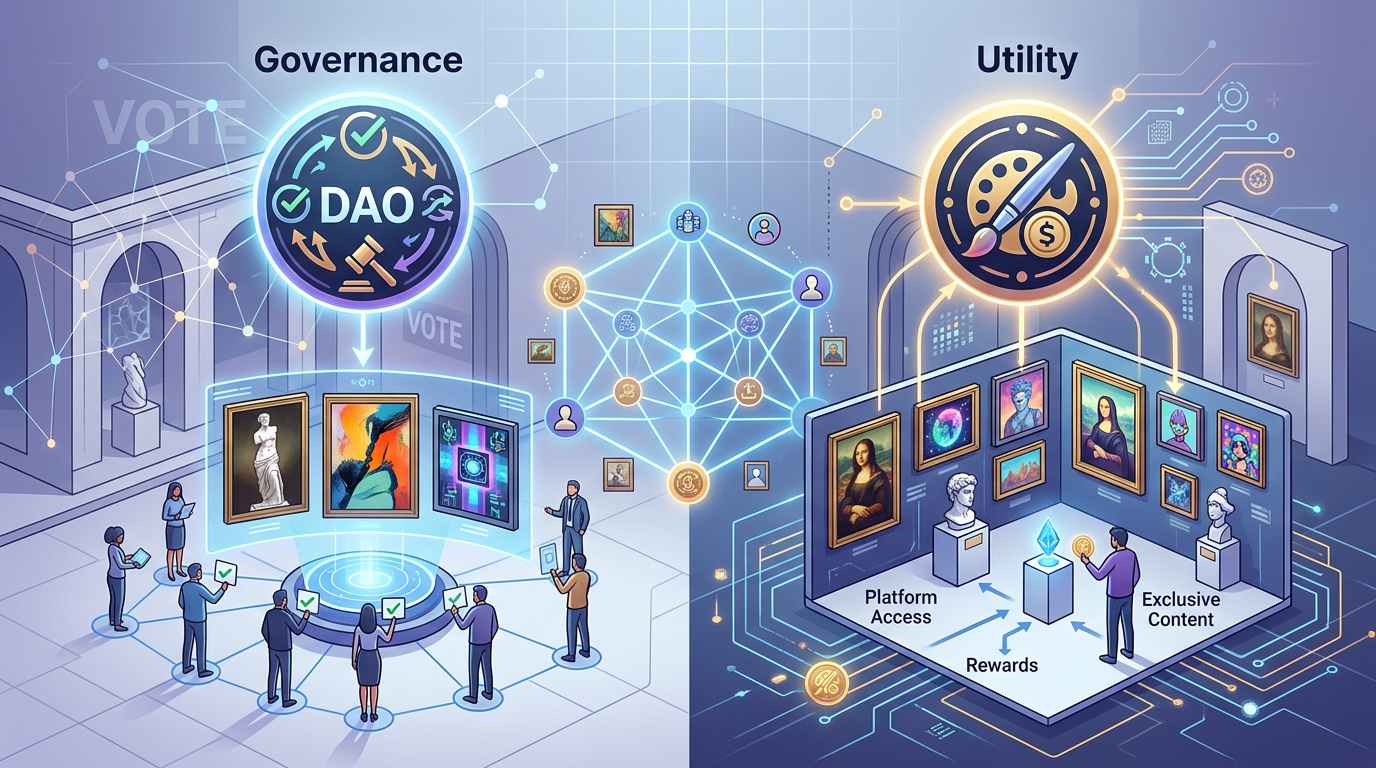
You’ve minted your first NFT, listed it on a marketplace, and noticed something strange. The platform doesn’t just accept payment in ETH or SOL. It has its own token. You can stake it for voting rights. You can earn it by curating. You can spend it to boost visibility. Suddenly, you’re not just an artist navigating a marketplace. You’re a participant in an economy.
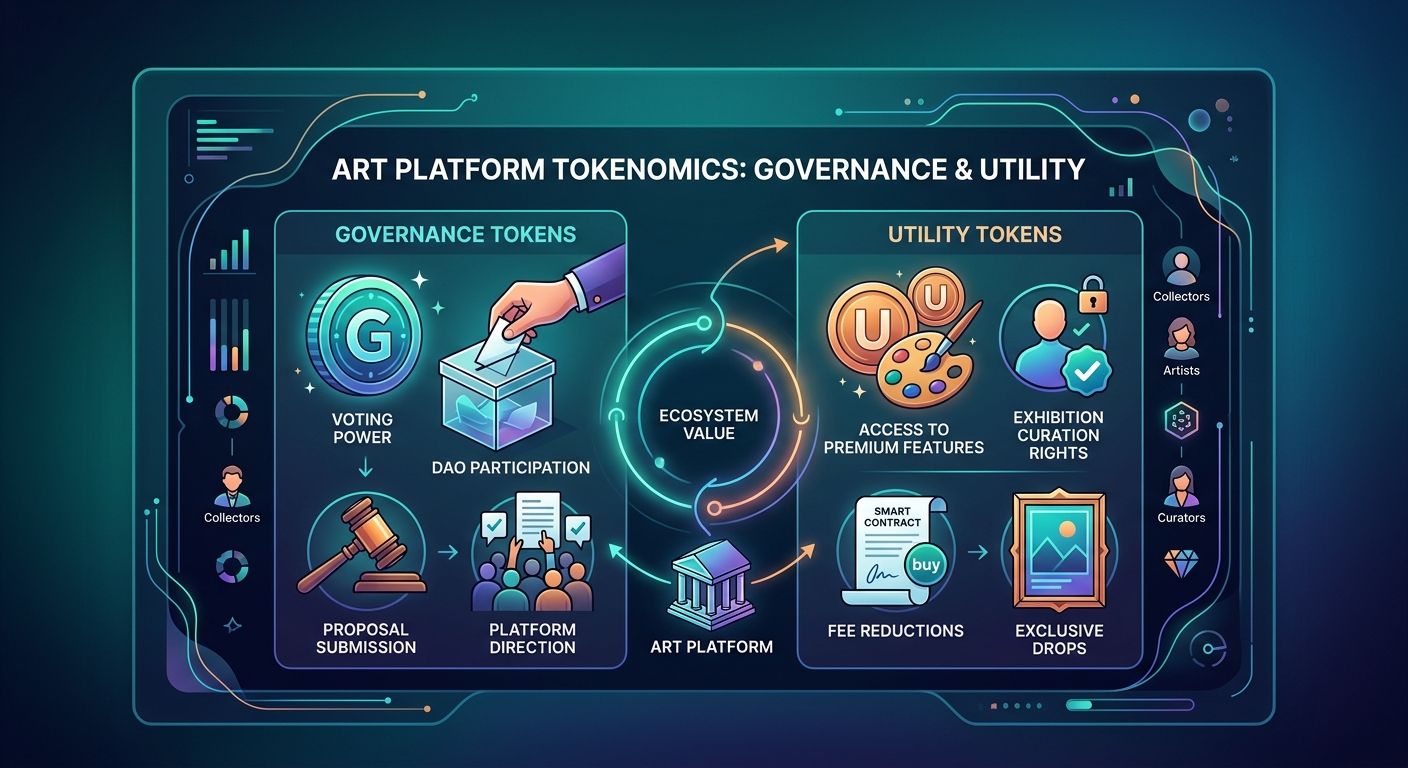
Tokenomics for art platforms describes how governance and utility tokens create incentives, distribute power, and sustain marketplace ecosystems. Governance tokens let holders vote on platform rules, while utility tokens grant access to features like curation, staking, and reduced fees. Understanding both helps artists maximize earnings and developers design sustainable platforms that align creator and collector interests.
What tokenomics actually means in art marketplaces
Tokenomics is the study of how a token works within its ecosystem. Think supply, demand, distribution, and incentives.
For art platforms, tokenomics determines who gets rewarded, who makes decisions, and how value flows between artists, collectors, curators, and the platform itself.
Most traditional art marketplaces operate on simple commission models. The platform takes 10% to 15% of every sale. Artists get the rest. Done.
Blockchain art platforms can do more. Tokens let platforms distribute ownership, align incentives, and reward behaviors that strengthen the ecosystem. Instead of extracting value, platforms can redistribute it.
But not all tokenomics models work. Some create unsustainable hype cycles. Others concentrate power in the hands of early adopters. The best models balance fairness, sustainability, and growth.
Governance tokens give artists a voice in platform decisions
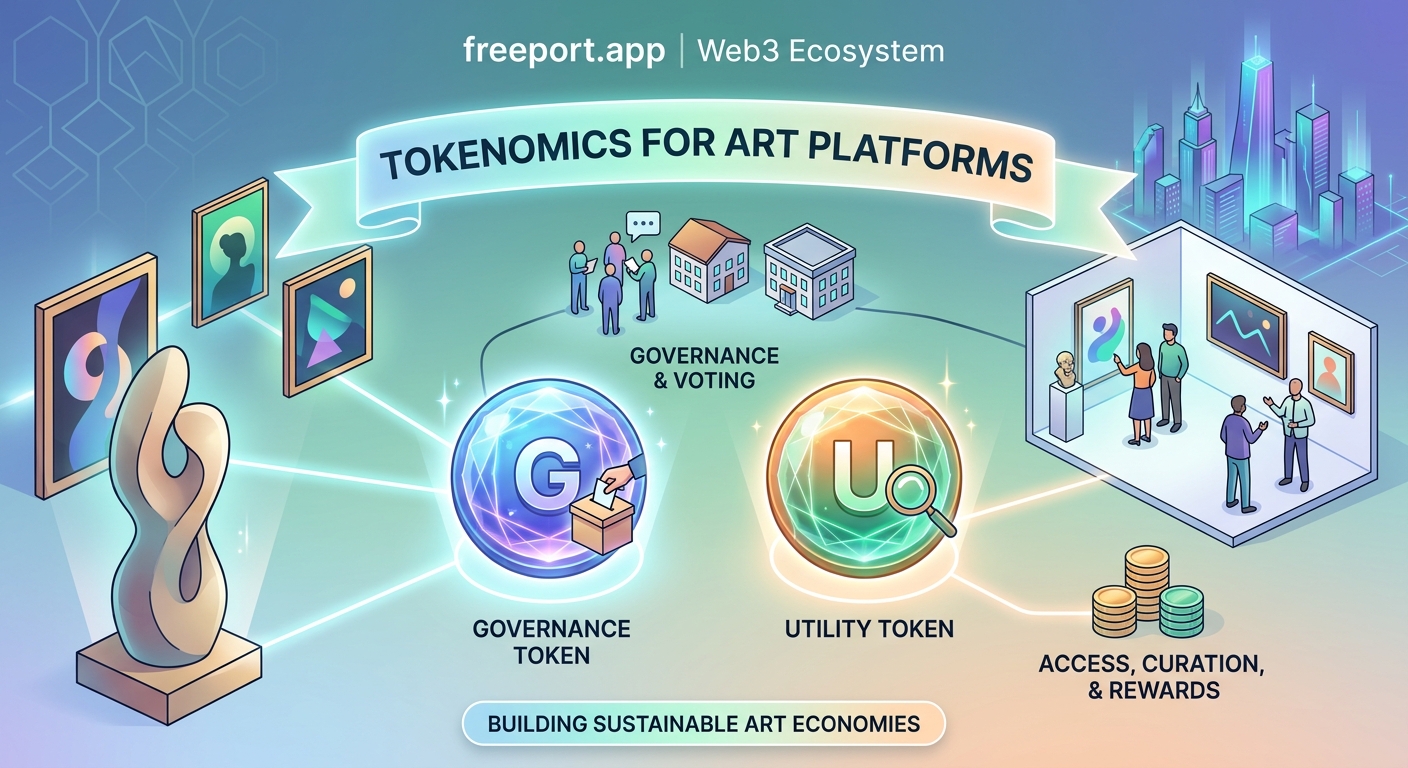
Governance tokens represent voting power. Hold them, and you can propose changes to the platform or vote on proposals submitted by others.
This matters because artists and collectors often have different priorities than platform founders. Artists want lower fees and better discovery tools. Collectors want authentication guarantees and liquidity. Founders want growth and profitability.
Governance tokens let the community shape the platform’s future. Proposals might include:
- Adjusting platform commission rates
- Adding new blockchain support
- Changing curation algorithms
- Allocating treasury funds to artist grants
- Modifying royalty enforcement policies
On platforms like SuperRare, governance token holders vote on which artists get invited to the curated marketplace. On others, they decide how platform revenue gets reinvested.
Not every holder votes. Participation rates often hover around 5% to 15%. But the option exists, and that changes the power dynamic.
Some platforms distribute governance tokens through airdrops to early users. Others require staking or activity thresholds. A few sell them outright, which concentrates power among wealthy participants.
The distribution method shapes who controls the platform. Broad distribution creates more democratic governance. Narrow distribution creates oligarchy.
Utility tokens unlock features and reduce friction
Utility tokens serve practical functions within the platform. They’re not about voting. They’re about access, discounts, and participation.
Common utility token functions include:
- Paying reduced platform fees
- Boosting artwork visibility in search and discovery
- Accessing exclusive drops or early minting windows
- Tipping artists directly
- Staking to earn curation rewards
- Unlocking premium analytics or portfolio tools
Foundation, for example, uses its token to let collectors bid on artworks and participate in community curation. Holders can stake tokens to signal which artists deserve attention, earning rewards when those artists succeed.
Utility tokens create closed-loop economies. Artists earn tokens from sales. Collectors earn tokens from staking or curation. Both spend tokens to access platform features. The platform benefits because token demand increases as activity grows.
But utility tokens face a challenge. If the only reason to hold them is platform access, their value depends entirely on platform health. If the platform declines, token value collapses.
The strongest utility tokens have multiple use cases. They work across several platforms or integrate with broader ecosystems. Cross-platform utility reduces risk and increases long-term viability.
How token supply and distribution affect long-term value
Token supply determines scarcity. Distribution determines who benefits.
Most art platform tokens launch with a fixed maximum supply, similar to Bitcoin’s 21 million cap. Others use inflationary models, minting new tokens over time to reward participation.
Fixed supply creates scarcity. If demand grows, price should rise. But if supply is too limited, it can exclude new participants and concentrate wealth.
Inflationary models reward ongoing activity. New tokens incentivize curation, staking, and community building. But inflation dilutes existing holders unless demand keeps pace.
Distribution typically follows this pattern:
- Team and advisors receive 15% to 25%, often with vesting schedules
- Early investors receive 10% to 20%, also vested
- Community rewards and ecosystem growth receive 30% to 50%
- Treasury reserves hold 10% to 20% for future initiatives
Vesting schedules prevent team members and investors from dumping tokens immediately after launch. Typical vesting lasts two to four years, with a six to twelve month cliff before any tokens unlock.
Community allocation matters most for artists and collectors. Platforms that reserve 40% or more for community rewards tend to build stronger ecosystems. Those that allocate less often struggle with engagement.
Building sustainable incentives without creating pump-and-dump cycles
Early token launches often follow a predictable pattern. Hype builds. Price spikes. Early holders sell. Price crashes. Community fractures.
Sustainable tokenomics avoids this cycle by aligning short-term incentives with long-term value creation.
Staking mechanisms help. When holders lock tokens for three, six, or twelve months, they commit to the platform’s future. They can’t panic sell during volatility.
Staking rewards should come from real platform revenue, not just newly minted tokens. Revenue-based rewards create genuine value distribution. Inflation-based rewards create Ponzi dynamics.
How smart contracts are revolutionizing art royalties in web3 demonstrates how programmable revenue streams can fund sustainable token rewards without relying on speculation.
Fee discounts also align incentives. If holding 1,000 tokens reduces your platform fee from 10% to 5%, you have a concrete reason to hold. The discount pays for itself if you’re an active seller.
Curation rewards work when they’re tied to actual outcomes. If you stake tokens to promote an artist and that artist’s work sells, you earn a percentage. If nothing sells, you earn nothing. This creates skin in the game.
“The best tokenomics models don’t just redistribute value. They create new value by coordinating behavior that wouldn’t happen otherwise. Curation, discovery, and community building all become economically rational activities.”
Common tokenomics mistakes that hurt artists and collectors
Not every token model succeeds. Some common failures include:
| Mistake | Why it hurts | Better approach |
|---|---|---|
| Excessive team allocation | Founders dump tokens, tanking price | Cap team allocation at 20%, use long vesting |
| No real utility | Token becomes pure speculation | Tie tokens to concrete platform benefits |
| Inflationary death spiral | New tokens dilute holders faster than demand grows | Use revenue-based rewards or capped inflation |
| Governance theater | Votes happen but platform ignores results | Implement binding on-chain governance |
| Whale concentration | Top 10 holders control 80% of supply | Distribute broadly through activity rewards |
The worst tokenomics models treat tokens as fundraising tools rather than ecosystem infrastructure. They sell tokens to raise capital, then struggle to create genuine utility afterward.
Artists suffer when platforms prioritize token price over artist success. If curation rewards favor hype over quality, the platform becomes a casino. Serious collectors leave. Serious artists follow.
Collectors suffer when platforms change token mechanics mid-flight. If staking rewards suddenly drop or fee discounts disappear, trust evaporates. Clear, predictable tokenomics builds confidence.
Evaluating a platform’s tokenomics before you commit
Before you mint on a new platform or buy its governance token, check these factors:
-
Read the tokenomics documentation. Look for clear explanations of supply, distribution, and utility. Vague promises are red flags.
-
Check the token distribution. If the team holds more than 25%, proceed carefully. If top holders control more than 50%, avoid entirely.
-
Verify vesting schedules. Team and investor tokens should vest over at least two years. Immediate liquidity suggests a cash grab.
-
Test the utility. Can you actually use the token for something meaningful? Fee discounts and curation rewards are real utility. Vague “ecosystem access” is not.
-
Review governance history. If the platform has governance tokens, check past proposals. Do votes matter? Does the team implement community decisions?
-
Analyze revenue sources. Does the platform generate real revenue from commissions and fees? Or does it rely entirely on token sales?
-
Compare to competitors. How does this platform’s tokenomics stack up against alternatives? Better models attract better artists and collectors.
The complete guide to minting your first fine art NFT walks through platform selection, including tokenomics evaluation as part of the decision process.
Real examples of tokenomics models in production
SuperRare uses a governance token called RARE. Holders vote on curation decisions, treasury allocation, and platform upgrades. The platform distributes tokens through:
- Collector rewards for purchasing art
- Artist rewards for sales volume
- Curation rewards for community participation
- Liquidity mining for providing token liquidity
Foundation launched with an invite-only model, then introduced community curation powered by token staking. Collectors stake tokens to vouch for artists. When those artists succeed, stakers earn rewards.
Zora takes a different approach. Instead of a platform token, it uses a protocol model where anyone can build a marketplace. Value accrues to the protocol through fees, which get distributed to participants.
Tezos-based platforms like Objkt use the native XTZ token rather than creating platform-specific tokens. This reduces complexity but limits governance options.
Each model makes tradeoffs. Platform tokens create stronger communities but add complexity. Protocol tokens reduce friction but dilute platform identity. Native blockchain tokens simplify onboarding but limit customization.
The right model depends on the platform’s goals. Curated marketplaces benefit from governance tokens that let the community shape curation standards. Open marketplaces work better with utility tokens that reduce friction.
How artists can maximize earnings through platform tokens
If you’re minting on a platform with tokenomics, you can optimize your strategy:
- Stake governance tokens to earn curation rewards while building reputation
- Hold utility tokens to reduce platform fees on your sales
- Participate in governance to shape platform features that benefit artists
- Time major drops around token reward multipliers or bonus periods
- Build relationships with token-holding curators who can boost your visibility
Some platforms offer higher token rewards during launch periods. Early participants earn more. This creates first-mover advantage but can also build loyal communities.
Royalties and rights: understanding artist compensation in blockchain art covers how tokenomics intersects with royalty structures to create multiple revenue streams.
Fee optimization matters. If you sell $50,000 worth of art annually and platform fees are 10%, you pay $5,000. If holding $2,000 worth of platform tokens reduces fees to 5%, you save $2,500 yearly. The tokens pay for themselves in year one.
Curation staking can amplify your reach. When prominent collectors stake tokens to vouch for your work, you gain visibility. Some artists reciprocate by staking for collectors’ favorite emerging artists, building mutual support networks.
Building tokenomics as a platform developer
If you’re building an art platform, your tokenomics design determines whether your ecosystem thrives or collapses.
Start with these questions:
- What behaviors do we want to incentivize?
- How do we prevent value extraction and encourage value creation?
- Who should have governance power, and how should it be distributed?
- What utility justifies holding our token long-term?
- How do we balance artist interests, collector interests, and platform sustainability?
Design token distribution to reward genuine participation. Airdrops to early users build loyalty. Activity-based rewards attract engaged community members. Governance rights create ownership mentality.
Avoid these pitfalls:
- Don’t launch a token just because other platforms have one
- Don’t treat tokens as a fundraising mechanism first and utility second
- Don’t promise governance without implementing binding vote mechanisms
- Don’t create inflationary rewards without revenue to back them
- Don’t concentrate supply among team and investors
What happens to your blockchain art when the platform shuts down? explores the importance of sustainable platform economics, including tokenomics that support long-term viability.
Revenue-sharing models work well. If your platform takes a 10% commission, consider distributing 3% to 5% back to token stakers. This creates genuine yield without relying on inflation.
Fee reduction models create immediate utility. Collectors and artists both benefit from lower costs, creating natural demand for the token.
Governance should be binding. If the community votes for a change and the team ignores it, governance becomes theater. Implement on-chain execution where possible, or commit to implementing passed proposals within defined timeframes.
The future of tokenomics in art marketplaces
Tokenomics models are evolving. Early platforms experimented with simple governance and utility tokens. Newer platforms are testing more sophisticated mechanisms.
Bonding curves automatically adjust token price based on supply and demand. When demand increases, price rises smoothly rather than spiking. When demand falls, price decreases gradually. This reduces volatility.
Quadratic voting gives more weight to broad consensus than to concentrated wealth. Instead of one token equaling one vote, voting power increases with the square root of tokens held. This prevents whales from dominating governance.
Retroactive public goods funding rewards past contributions rather than speculating on future value. Platforms allocate treasury funds to artists and curators who already created value, rather than promising future rewards.
Cross-platform token standards are emerging. Instead of each marketplace having its own token, groups of platforms might share governance tokens, creating network effects and reducing fragmentation.
Layer 2 solutions: why Ethereum artists are migrating to Polygon and Arbitrum discusses how technological improvements enable more sophisticated tokenomics with lower transaction costs.
Hybrid models combining governance and utility in single tokens are gaining traction. This simplifies the user experience while maintaining both functions.
Reputation-weighted governance might replace or supplement token-weighted voting. Platforms could grant voting power based on contribution history, not just token holdings. Active curators and successful artists would gain influence regardless of wealth.
Why understanding tokenomics protects your creative practice
Tokenomics isn’t just abstract economics. It determines how much you earn, who controls the platforms you use, and whether those platforms survive long enough to matter.
Artists who understand tokenomics can:
- Choose platforms with sustainable economics
- Optimize fee structures and reward programs
- Participate in governance to protect artist interests
- Identify red flags before committing to new marketplaces
- Build strategies that maximize both creative and financial success
Platform developers who master tokenomics can:
- Design ecosystems that attract and retain top talent
- Create genuine value rather than speculative bubbles
- Align community interests with platform success
- Build sustainable businesses that outlast hype cycles
- Differentiate their platforms through superior incentive design
7 blockchain artists redefining contemporary digital art in 2026 profiles artists who successfully navigate platform tokenomics to build sustainable careers.
The platforms that survive the next five years won’t be those with the highest token prices. They’ll be those with tokenomics that genuinely serve artists and collectors, creating value rather than extracting it.
Start by examining the platforms you already use. Check their token distribution. Review their governance history. Test their utility features. Compare their models to competitors.
Then apply that knowledge. Optimize your fee structure. Participate in governance votes. Stake tokens strategically. Build relationships with curators who can amplify your work.
Tokenomics might seem complicated at first. But once you understand the basics, you’ll see the patterns. You’ll recognize sustainable models and spot unsustainable hype. You’ll make better decisions about where to mint, where to collect, and where to build your creative practice.
The art world is changing. Tokenomics is one of the tools that lets artists and collectors shape that change rather than just react to it.