The Real Cost of Minting: Gas Fees, Platform Commissions, and Hidden Expenses Explained

You’ve created your digital artwork and you’re ready to mint your first NFT. But before you hit that button, understanding the full cost of minting NFT can save you from an unpleasant surprise when fees eat into your profits or even exceed your initial sale price.
The cost of minting NFT ranges from under $1 on layer 2 networks to over $100 on Ethereum during peak times. Total expenses include blockchain gas fees, platform commissions (typically 2.5% to 15%), storage costs, wallet setup, and listing fees. Creators can reduce costs by 90% or more by choosing alternative blockchains, minting during off-peak hours, or using lazy minting options that defer fees until sale.
Understanding blockchain gas fees
Gas fees represent the computational energy required to process your transaction on a blockchain network. Think of them as the toll you pay to have miners or validators process and record your NFT creation permanently.
On Ethereum, gas fees fluctuate wildly based on network congestion. During busy periods, a single mint can cost $50 to $150. During quieter times, that same transaction might run $10 to $30.
The fee doesn’t reflect the value of your artwork. A $100 piece and a $10,000 piece cost the same to mint because the blockchain processes them identically.
Gas fees get calculated in “gwei,” which are tiny fractions of the native cryptocurrency. One gwei equals 0.000000001 ETH. A typical NFT mint consumes 80,000 to 150,000 gas units. Multiply those units by the current gwei price, and you get your total gas cost.
Network activity drives these prices up during weekdays and U.S. business hours. Weekends and late-night hours (EST) typically offer lower rates. Some creators save 60% simply by timing their mints strategically.
Platform commission structures
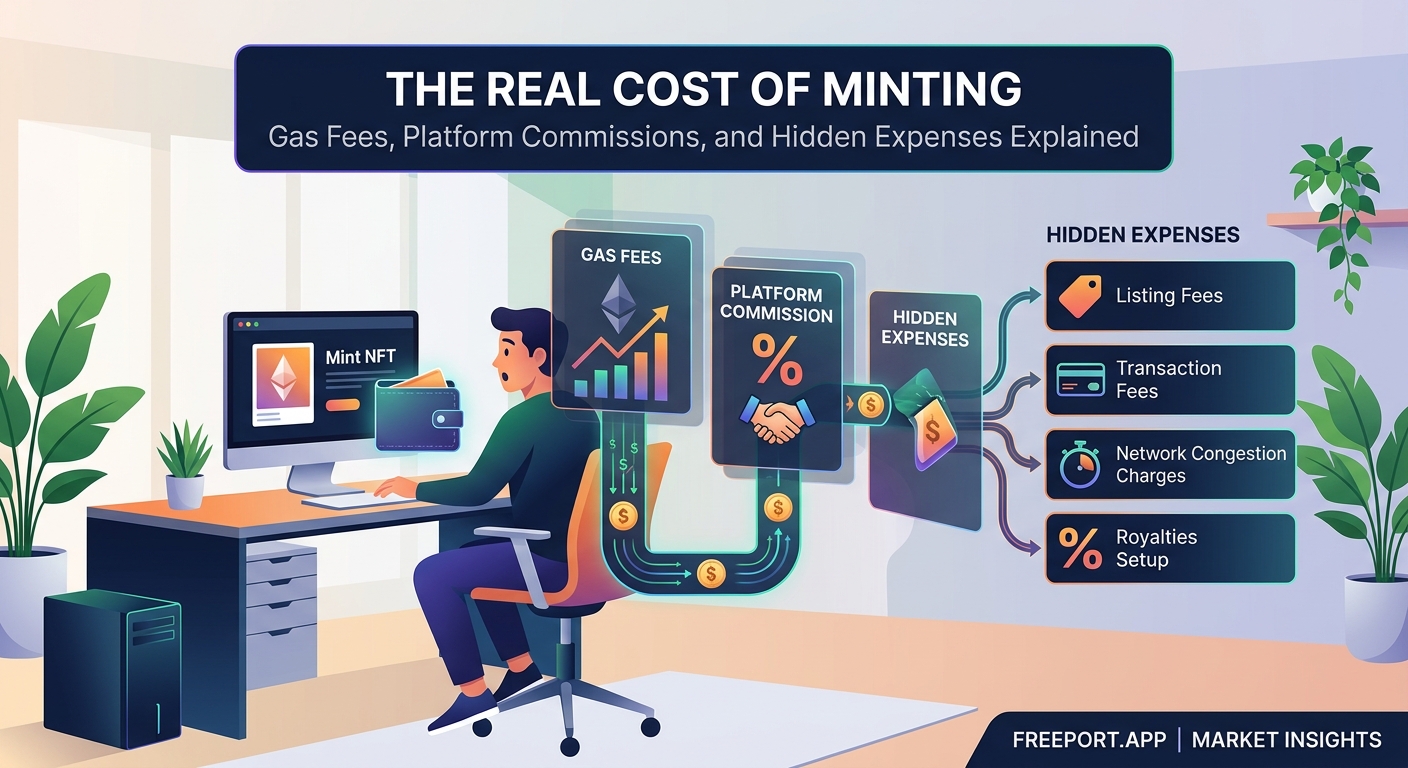
Every NFT marketplace takes a cut of your sales. These percentages vary significantly and directly impact your profitability.
OpenSea charges 2.5% on each sale. Rarible takes 2.5% as well. Foundation charges 15% on primary sales but only 2.5% on secondary transactions. SuperRare takes 15% on primary sales and 3% on secondary market trades.
Some platforms also charge listing fees just to put your work up for sale, regardless of whether it sells. These can range from $5 to $100 depending on the blockchain and marketplace.
Here’s where it gets tricky. These percentages apply to the sale price, not your profit. If you sell a piece for $500 on Foundation, you lose $75 to platform fees before considering gas costs, royalties to previous owners, or your original minting expense.
| Platform | Primary Sale Fee | Secondary Sale Fee | Listing Fee |
|---|---|---|---|
| OpenSea | 2.5% | 2.5% | Free |
| Rarible | 2.5% | 2.5% | Free |
| Foundation | 15% | 2.5% | Free |
| SuperRare | 15% | 3% | Application required |
| Nifty Gateway | 5% + 30¢ | 5% + 30¢ | Free |
Many creators forget that smart contract royalties explained: protecting artist revenue in secondary sales can help offset these platform fees through ongoing revenue.
Storage and hosting expenses
Your NFT metadata and artwork files need permanent storage. This represents an ongoing cost many creators overlook.
Most platforms store your image on centralized servers initially. But for true permanence and decentralization, you need IPFS (InterPlanetary File System) or Arweave storage.
IPFS storage through Pinata costs around $20 per month for 100GB. NFT.Storage offers free IPFS pinning but relies on protocol funding that may not last forever.
Arweave provides permanent storage for a one-time fee. Uploading a 10MB file costs roughly $0.50 to $2 depending on network conditions. A high-resolution artwork file might run $5 to $15 for permanent storage.
Some creators use hybrid approaches. They store thumbnails on-chain (expensive but permanent) and full files on IPFS or Arweave. This balances cost with accessibility.
For collections of 10,000 items, storage costs alone can reach $5,000 to $20,000 before any minting occurs. Many projects underestimate this expense and struggle with sustainability.
Understanding decentralized storage wars: IPFS vs Arweave for long-term NFT preservation helps you make informed decisions about where your artwork lives permanently.
Wallet setup and transaction costs
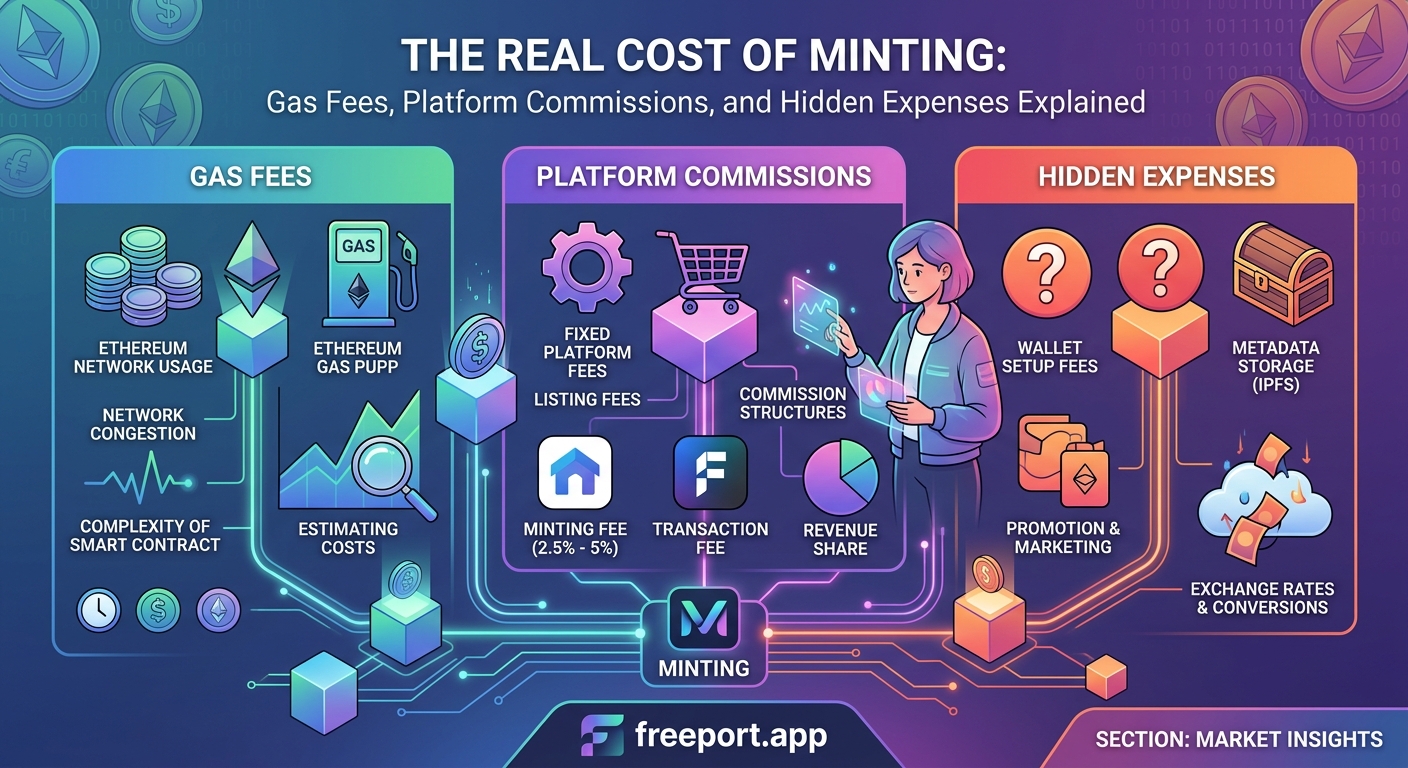
Before minting anything, you need a crypto wallet. MetaMask, Rainbow, and Coinbase Wallet offer free downloads, but using them costs money.
First, you need cryptocurrency to pay gas fees. Buying ETH through an exchange involves:
- Exchange fees (0.5% to 2% of purchase amount)
- Network fees to transfer ETH from exchange to your wallet ($5 to $25)
- Potential price slippage if markets move while processing
A $500 ETH purchase might cost $510 to $525 after all fees. That’s before you’ve minted anything.
Some wallets charge transaction fees on top of gas. Coinbase Wallet adds a small percentage to each transaction. MetaMask shows you the raw gas cost but some users pay more by accepting suggested “fast” transaction speeds.
Contract interaction fees also add up. Approving a marketplace to sell your NFTs costs gas. Transferring NFTs between wallets costs gas. Accepting bids costs gas. Each action runs $10 to $50 on Ethereum.
Alternative blockchain options
Ethereum isn’t your only choice. Other blockchains offer dramatically lower costs.
Polygon (a layer 2 solution) charges gas fees under $0.01 per transaction. Minting 100 NFTs might cost $0.50 total. The tradeoff? Smaller collector base and potentially lower sales prices.
Tezos charges around $0.02 to $0.10 per mint. The platform Hic et Nunc (now Teia) built a thriving art community on these low costs.
Solana minting runs $0.00025 per transaction. Yes, less than a penny. Magic Eden and Solanart host major collections on this network.
Flow blockchain (home to NBA Top Shot) charges fees in FLOW tokens, typically $0.01 to $0.05 per mint.
“I minted my first 50 pieces on Ethereum and spent $2,400 in gas fees. I moved to Polygon and minted 500 more pieces for under $20 total. The Ethereum pieces didn’t sell better just because they cost more to create.” – Digital artist Sarah Chen
The real question isn’t which blockchain costs less, but where your audience lives. Ethereum collectors often won’t buy on Polygon, and vice versa. Many creators now mint on multiple chains to test different markets, as explored in layer 2 solutions: why Ethereum artists are migrating to Polygon and Arbitrum.
Lazy minting and deferred costs
Lazy minting lets you list NFTs without paying upfront gas fees. The buyer pays minting costs when they purchase.
OpenSea and Rarible both offer lazy minting. You create the NFT metadata and listing, but the token only gets written to the blockchain when someone buys it.
This approach eliminates risk. You don’t spend $100 minting something that never sells. The buyer pays gas as part of their purchase transaction.
The downside? Buyers see the extra cost and may negotiate your price down or skip the purchase entirely. A piece listed at $200 might cost the buyer $240 after gas, making them reconsider.
Some collectors also prefer “pre-minted” NFTs because they’re already on-chain. Lazy-minted pieces feel less established to certain buyers.
For new creators testing the market, lazy minting makes perfect sense. You can list 50 pieces with zero upfront cost and see what resonates. Once you understand demand, you might switch to traditional minting for premium pieces.
Hidden costs creators miss
Beyond the obvious fees, several expenses catch creators off guard.
Marketing and promotion: Getting eyes on your work costs money. Twitter ads, Instagram promotion, Discord server tools, and collaboration fees add up. Budget $100 to $1,000 per collection for basic marketing.
Failed transactions: When gas prices spike mid-transaction, your mint might fail. You lose the gas fee but don’t get the NFT. This happens more often than you’d think during network congestion.
Smart contract audits: If you’re deploying custom contracts, professional audits cost $5,000 to $50,000. Skipping this step risks bugs that could lock funds or break functionality.
Metadata updates: Changing your NFT description or fixing errors costs gas. Each update is a new transaction with associated fees.
Tax preparation: NFT transactions create complex tax situations. Professional crypto tax software runs $50 to $500 annually. Accountant fees for NFT income can exceed $1,000.
Domain names: Custom ENS domains (yourname.eth) cost $5 to $640 per year depending on name length. Many creators buy these for branding but forget the renewal costs.
The complete guide to minting your first fine art NFT covers many of these overlooked expenses in detail.
Calculating your break-even point
Before minting, calculate exactly what you need to earn to profit.
Start with direct costs:
– Gas fee for minting: $50
– Storage (Arweave): $10
– Wallet funding fees: $15
– Marketing budget: $200
Total upfront: $275
Now add percentage-based costs:
– Platform fee (15% on Foundation): Applied to sale price
– Creator royalty to yourself (10%): Only on secondary sales
If you price your NFT at $500, you receive $425 after Foundation’s 15% fee. Subtract your $275 in costs, and you net $150 profit.
But if the piece sells for $200, you get $170 after fees. Subtract $275 in costs, and you’ve lost $105.
Your break-even sale price is $324 ($275 ÷ 0.85 = $323.53).
This math changes dramatically on cheaper blockchains. On Polygon, your costs might be:
– Gas: $0.50
– Storage: $10
– Wallet fees: $5
– Marketing: $200
Total: $215.50
Your break-even at 2.5% platform fees is $221 ($215.50 ÷ 0.975 = $221.03).
Lower minting costs give you pricing flexibility and reduce risk substantially.
Strategies to minimize minting expenses
Smart creators use several tactics to keep costs down.
Time your transactions: Use tools like Etherscan Gas Tracker or Gas Now to monitor real-time gas prices. Mint during low-traffic periods (weekends, late nights EST) to save 40% to 70%.
Batch operations: Minting multiple NFTs in one transaction costs less per item than minting individually. A 10-item batch might cost $80 total ($8 per NFT) versus $50 each for individual mints.
Start on cheaper chains: Build your audience on Polygon or Tezos where experimentation costs pennies. Once you have collectors, consider Ethereum for premium pieces.
Use platform subsidies: Some marketplaces subsidize gas during promotional periods. Foundation occasionally covers gas for selected artists. Zora has offered gas rebates for certain collections.
Optimize file sizes: Smaller files cost less to store permanently. A 50MB video file might cost $25 to store on Arweave, while a compressed 5MB version costs $2.50. Quality matters, but many creators upload unnecessarily large files.
Bundle metadata: Instead of storing each NFT’s metadata separately, some collections use a single base URI with token IDs. This reduces storage costs for large collections.
Wait for network upgrades: Major Ethereum updates sometimes reduce gas costs temporarily. Monitoring development news can help you time expensive operations.
Many successful creators featured in 7 blockchain artists redefining contemporary digital art in 2026 started on low-cost chains before moving to Ethereum.
Real-world cost examples
Let’s look at actual scenarios creators face.
Scenario 1: Single artwork on Ethereum
– Gas for minting: $65
– IPFS storage (monthly): $2
– OpenSea listing: Free (lazy mint available)
– Marketing: $50 (Twitter promotion)
– Total upfront: $117
– Break-even price at 2.5% fee: $120
Scenario 2: 10-piece collection on Polygon
– Gas for 10 mints: $0.50
– Arweave storage: $15
– Rarible listing: Free
– Marketing: $150 (Discord ads, Twitter)
– Total upfront: $165.50
– Break-even per piece at 2.5% fee: $17
Scenario 3: 10,000-item generative collection on Ethereum
– Smart contract deployment: $1,200
– Contract audit: $8,000
– Metadata storage (IPFS): $300
– Image storage (Arweave): $5,000
– Marketing: $15,000
– Website development: $3,500
– Total upfront: $33,000
– Break-even at 5% royalties on $150 mint price: 220 sales
These numbers show why generative art on the blockchain: where code meets canvas requires significant upfront investment but can scale profitably.
Tax implications of minting costs
Minting costs are generally deductible business expenses if you’re creating NFTs professionally.
When you mint an NFT, you create inventory. The IRS treats this similarly to a painter buying canvas and paint. Your minting fees, gas costs, storage expenses, and marketing all qualify as cost of goods sold (COGS).
If you mint an NFT for $100 in total costs and sell it for $500, you report $400 in income ($500 – $100 COGS).
However, if you mint and don’t sell, you can’t deduct those costs until the sale occurs or you abandon the project. Holding unsold NFTs creates “inventory” on your balance sheet.
Gas fees paid in cryptocurrency create additional complexity. The IRS treats crypto-to-crypto transactions as taxable events. Paying 0.05 ETH in gas when ETH is worth $2,000 is different from paying 0.05 ETH when it’s worth $3,000.
Professional tax software like CoinTracker or TokenTax helps track these transactions, but expect to spend time reconciling wallet activity with your records.
Many creators don’t realize that receiving payment in cryptocurrency also triggers reporting requirements. If someone buys your NFT for 1 ETH, you must report the USD value at the time of sale, even if you don’t convert to dollars.
When free minting isn’t actually free
Several platforms advertise “free minting,” but hidden costs remain.
OpenSea’s lazy minting is free to create the listing, but someone pays gas eventually. If you transfer the NFT to your own wallet before sale, you pay. If the buyer purchases, they pay.
Some platforms cover gas but charge higher platform fees. A marketplace might offer free minting but take 10% instead of 2.5%. On a $1,000 sale, that’s $75 extra versus paying $50 in gas upfront.
“Gasless” minting on certain platforms means the platform subsidizes costs temporarily. They might limit how many free mints you get or require holding their token to qualify.
Credit card checkout options let buyers pay in dollars, but the platform converts that to crypto and charges 3% to 5% processing fees on top of standard platform commissions.
Free often means “we’re absorbing this cost now to build user base.” When subsidies end, prices adjust. Early adopters benefit, but sustainability questions remain, as discussed in what happens to your blockchain art when the platform shuts down?.
Making informed decisions about your first mint
Understanding the full cost of minting NFT empowers you to price appropriately and choose the right platform for your goals.
Start by calculating your total investment: gas, storage, marketing, and time. Then research where your target collectors actually buy. Ethereum dominates high-value art sales, but thriving communities exist on every major chain.
Consider starting small. Mint one piece on your chosen platform to experience the process firsthand. The $50 to $100 you spend learning the system prevents costly mistakes on larger projects.
Track every expense in a spreadsheet. Note gas prices, transaction hashes, storage costs, and platform fees. This data helps you optimize future mints and provides documentation for tax purposes.
Don’t let fees paralyze you. Yes, costs add up, but so does the opportunity cost of never launching. Many successful creators spent $500 learning the ropes before finding their audience and earning back multiples of that investment.
The NFT space rewards those who understand both the creative and financial sides of digital art. Your first mint might not profit, but the knowledge you gain positions you for long-term success in this evolving market.