What Happens to Your Blockchain Art When a Layer-2 Network Fails?
You bought that gorgeous generative piece on a layer 2 to save on gas fees. Smart move. Ethereum mainnet fees were brutal, and the L2 made minting feel almost free. But then a question creeps in during a quiet night: what actually happens to your blockchain art if that layer 2 network just stops working? It is a valid fear, and one that every serious collector needs to understand.
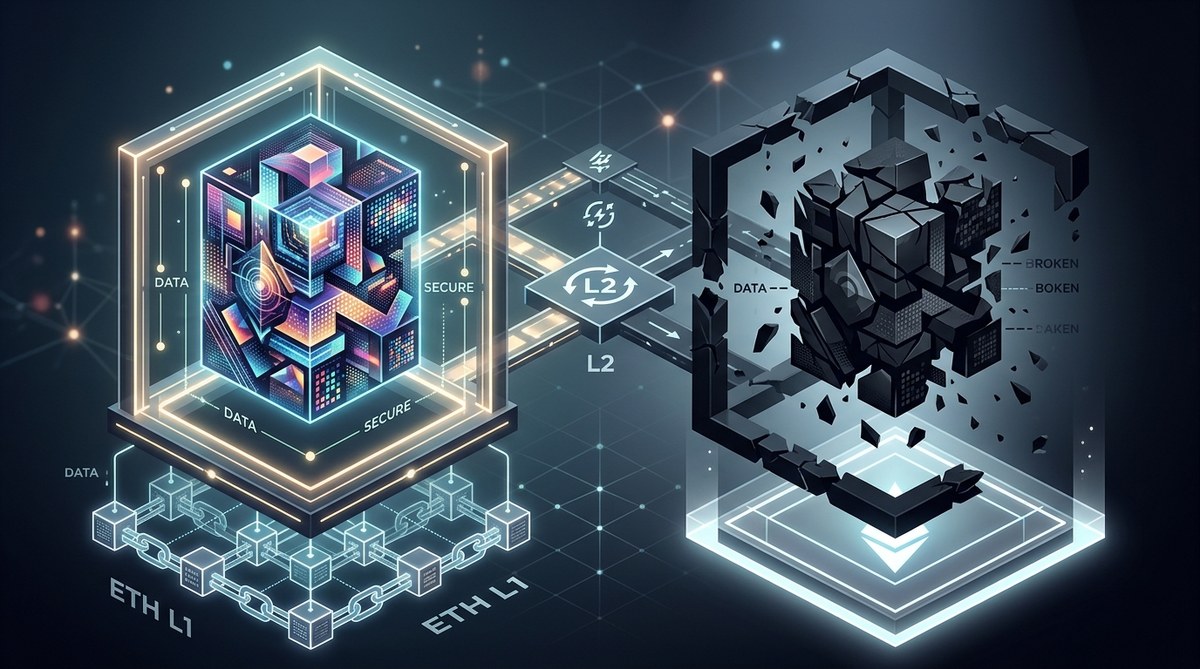
Your blockchain art on a layer 2 is not lost forever if the network fails. Most L2s post state roots and transaction data to Ethereum mainnet. You can use a force exit or a trustless bridge to reclaim your assets. The real risk is centralized sequencers and unverified contracts. Always check if your L2 has a working escape hatch before you collect.
How Layer 2 Networks Actually Work With Your Art
Layer 2 solutions are built on top of Ethereum (or another base layer) to process transactions faster and cheaper. Think of them as express lanes on a highway. The main road is Ethereum mainnet, and the express lane is the L2. Both get you where you need to go, but the express lane moves quicker and costs less.
When you mint an NFT on an L2, the smart contract that holds your token lives on that secondary network. The art itself is often stored on IPFS or Arweave, so the visual file is not directly tied to the L2. But the ownership record, the token ID, and the contract logic all reside on the layer 2.
The key safety feature is that L2s periodically post “checkpoints” to Ethereum mainnet. These checkpoints contain compressed data about the state of the L2, including who owns which tokens. This is the safety net that makes recovery possible.
What Happens When a Layer 2 Network Goes Dark
A layer 2 network can fail in a few ways. The team behind it might abandon the project. A critical bug could halt the sequencer. Or the network could suffer a governance attack. In each case, the immediate effect is the same: you cannot move your art, trade it, or interact with it on that L2.
But here is the good news. Because those checkpoints exist on mainnet, your ownership is not erased. The data proving you own that NFT is still recorded on Ethereum. The problem is that you need a way to prove that ownership and pull your assets out.
Different L2 architectures handle this differently. Optimistic rollups have a built in challenge period. ZK rollups use validity proofs. Some L2s have no recovery mechanism at all if they were designed poorly. This is why you need to know what you are buying into.
The Three Recovery Paths for Your Blockchain Art
If your L2 goes down, you have three main options to get your art back. Each one depends on how the network was built.
-
Use the escape hatch (force exit). Many legitimate L2s include a function called a force exit or a withdrawal delay. You can submit a transaction on mainnet that triggers a withdrawal. The L2 sequencer must process it within a set time window. If the sequencer is offline, you can wait for the delay to expire and then claim your assets directly on mainnet.
-
Deploy a trustless bridge. Some communities build recovery bridges after a failure. These bridges read the L2 state from mainnet checkpoints and allow you to prove your ownership. You submit a merkle proof showing your token ID and the block number. The bridge contract verifies it and releases your NFT on mainnet.
-
Wait for a community fork. If the L2 was open source, the community can spin up a new version of the network using the last known good state. This happened with a few smaller chains in 2024 and 2025. It is not guaranteed, but it is possible.
Common Mistakes That Make Recovery Harder
Not all L2s are created equal. Some design choices make recovery much more difficult. Here are the biggest red flags to watch for.
| Red Flag | Why It Matters | What to Do Instead |
|---|---|---|
| No mainnet checkpointing | The L2 never posts state data to Ethereum. If it goes down, there is no proof of your ownership. | Only collect on L2s that post data to mainnet. |
| Centralized sequencer with no escape hatch | The team controls the only way out. If they stop, you are stuck. | Check for a documented force exit function. |
| Proprietary bridge contracts | You cannot verify the bridge code yourself. It could have backdoors or no recovery path. | Stick to L2s with open source, audited contracts. |
| No withdrawal delay mechanism | There is no fallback if the sequencer goes offline. | Look for L2s with a minimum 7 day withdrawal window. |
How to Check Your L2 Before You Collect
Before you mint that next piece, do a little homework. It takes ten minutes and could save you a lot of stress.
- Visit the L2 block explorer and find the contract for your NFT.
- Look for functions related to “withdraw” or “claim” or “force exit.”
- Check if the project has a documented recovery process on their docs site.
- See if the L2 uses Ethereum mainnet as a data availability layer. If the data is only stored on the L2 itself, that is a risk.
- Search for any past incidents. Has the network ever gone down before? How did they handle it?
“The most important question you can ask about any layer 2 is this: if the sequencer stops working tomorrow, how do I get my art back? If the answer is not clear, do not buy.” – Anonymous L2 engineer from a major rollup project
What About the Art File Itself?
Your NFT token proves ownership, but the actual image or video file is usually stored elsewhere. Most blockchain art uses IPFS or Arweave for the media. Those are separate systems from the L2. Even if the L2 fails completely, the art file remains accessible through its content hash.
The real loss would be the ownership record. Without the L2, you cannot prove you own that specific token. This is why the checkpoint data on mainnet is so critical. It preserves the link between your wallet address and the token ID.
If you want extra safety, consider using a service like Freeport that helps you manage and verify your collection across multiple networks. Having a clear inventory of your assets, with their token IDs and contract addresses, makes recovery much easier if something goes wrong.
Building a Safer Collection Strategy
You do not need to abandon L2s entirely. They offer real benefits for collectors. Lower fees mean you can afford to mint more pieces. Faster transactions mean you can catch drops that would be impossible on mainnet. The trick is to balance convenience with safety.
- Keep your most valuable pieces on mainnet or on a well established L2 like Arbitrum or Optimism.
- Use newer or smaller L2s for experimental or lower value art.
- Always withdraw your art to mainnet if you plan to hold it long term.
- Maintain a spreadsheet or database of your collection with token IDs, contract addresses, and the network they live on.
The Real Risk Is Not What You Think
Most collectors worry about a total network collapse. That is rare. The more common risk is a bridge hack or a smart contract exploit. In 2025, several L2 bridges were drained because of vulnerabilities in the withdrawal logic. The art itself was safe on the L2, but the bridge that connected it to mainnet was compromised.
This is why you should understand the bridge architecture of any L2 you use. A bridge is a smart contract that locks tokens on one side and mints them on the other. If that contract has a bug, your art can be stolen even if the L2 itself is fine.
Your Next Steps as a Collector
You have put time and money into building your collection. A layer 2 failure does not have to mean losing everything. The technology is designed with recovery paths, but you need to know how to use them.
Start by auditing your current holdings. Which L2s are they on? Do those networks have a documented escape hatch? If you find any that do not, consider moving those pieces to mainnet or a more reliable L2.
For future purchases, make it a habit to check the L2’s recovery mechanisms before you hit that mint button. A few minutes of research now can save you weeks of stress later.
Staying Ahead of the Curve
The L2 landscape changes fast. New solutions appear, and old ones get upgraded. Stay connected with the communities around the networks you use. Follow their developer blogs and governance forums. If a network is planning a major upgrade or facing a crisis, you will hear about it there first.
You can also use tools that monitor the health of various L2s. These track sequencer uptime, bridge activity, and withdrawal delays. A sudden drop in activity or a prolonged halt in block production is a warning sign.
Your blockchain art collection is a real asset. Treat it with the same care you would give a physical painting. Know where it lives, how to move it, and what to do if the network around it fails. That knowledge is the best insurance you can buy.