5 Ways Decentralized Autonomous Organizations Are Changing the Blockchain Art World
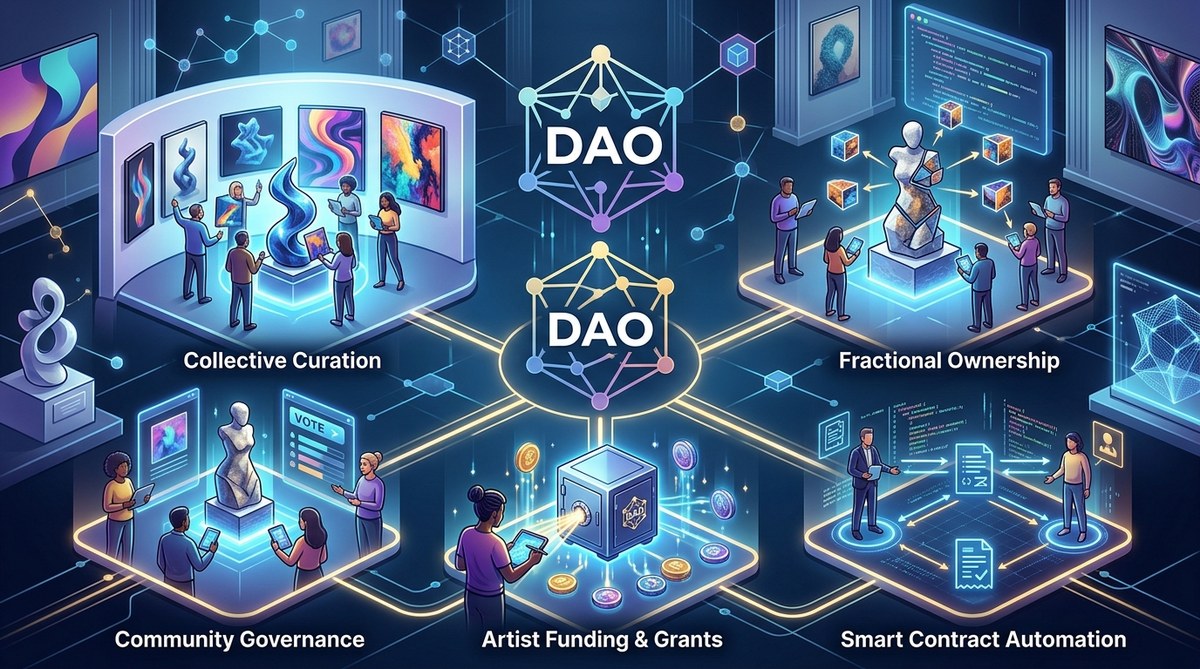
Picture this: You are standing in a virtual gallery, surrounded by art you helped select. The walls change based on votes you cast. The next exhibition is funded by a treasury you own a piece of. That is not a futuristic fantasy. It is what DAOs are doing to the blockchain art world right now. Decentralized autonomous organizations are replacing gatekeepers with community votes, and they are changing everything about how art is made, bought, and collected.
DAOs blockchains art are not just buzzwords. They represent a shift from top-down galleries to community-owned ecosystems. Artists get fair royalties enforced by smart contracts. Collectors vote on acquisitions. Funding becomes transparent. In 2026, joining an art DAO is one of the most direct ways to shape the future of digital collecting while sharing in its upside.
What Are DAOs in the Blockchain Art World?
A DAO is an organization run by code instead of a boardroom. Members hold tokens that give them voting power. When a decision needs to be made, the community proposes and votes. The smart contract executes the result automatically. No emails, no meetings, no middleman.
In the art world, DAOs do three things really well. They pool money for big purchases, they let collectors vote on what to buy, and they enforce rules like royalties through blockchain logic. If you have ever wished you could help curate a museum from your couch, a blockchain art DAO is your ticket.
5 Ways DAOs Are Changing the Blockchain Art Game
1. Collective Curation Let You Decide What Gets Displayed
Traditional galleries have curators with personal tastes. DAOs open the process to everyone. A member proposes a piece, other members vote, and if it passes, the DAO buys it. This means you get exposed to art that would never make it through a conventional gallery vetting process.
Some DAOs even let you curate themed exhibitions. You propose a collection around a concept like “digital decay” or “generative landscapes.” If the community agrees, the show goes live. Your taste becomes part of the record.
2. Transparent Funding Ends the Mystery of Art Deals
In the old system, a collector might buy a piece for $10,000, and nobody knows what the artist actually received. DAOs put everything on chain. Every bid, every royalty split, every treasury movement is visible to anyone with a block explorer.
This transparency matters for artists. If a DAO votes to fund a new series, the artist can see exactly how much is reserved, where the money comes from, and when it will be released. No more vague promises or delayed payments.
3. On-Chain Governance Gives You a Say in Platform Rules
DAO tokens often govern the platform itself. You vote on fee structures, curation standards, and even which blockchain the platform supports. In 2026, many blockchain art marketplaces are run as DAOs. Want lower fees for generative art? Propose it. Want to ban wash trading? Vote on it.
Governance tokens are not just for whales. Many DAOs use quadratic voting or delegation so small holders can still influence outcomes. Your single vote matters more than you think.
4. Fractional Ownership Unlocks Blue-Chip Art
Not everyone can afford an eight-figure Beeple. DAOs solve that by letting you buy a slice. You pool funds with other members, purchase the piece, and hold it in a shared multisig wallet. Then you divide ownership into tokens. You can trade your fractional shares later or keep them for voting.
This model is especially powerful for blockchain art that might appreciate but is out of reach for individual collectors. Check out our guide on https://freeport.app/fractional-ownership-is-changing-digital-collecting-forever/ to see how shared ownership really works.
5. Permanent Royalties Enforced by DAO Rules
One of the biggest battles in NFTs is royalties. Some marketplaces let sellers skip them. But a DAO can enforce royalty payments through its own smart contract rules. If the DAO controls the marketplace, every resale automatically sends a percentage to the original artist.
This changes the game for creators. Instead of relying on marketplace goodwill, artists get a code-enforced revenue stream. For a deeper look at how smart contracts protect artist income, read
How to Get Involved With an Art DAO in 2026
Joining a DAO is simpler than you think. Here is a step-by-step process:
- Choose a DAO that matches your interests. Some focus on generative art, others on photography, others on AI-assisted works. Research the community culture on Discord or Warpcast before buying tokens.
- Acquire the governance token. You usually need the DAO’s native token to vote. You can buy it on a DEX like Uniswap or earn it by contributing work or liquidity.
- Submit a membership proposal if required. Some DAOs use on-chain applications. You write a short bio and explain why you want to join. The community votes.
- Participate in votes. Start with low-stakes proposals like exhibition themes or budget allocations. Build your reputation before proposing major changes.
- Contribute skills. DAOs need designers, developers, writers, and marketers. Many offer bounties or contributor roles that reward you with tokens or influence.
Common Mistakes Artists and Collectors Make With DAOs
| Mistake | Why It Happens | How to Avoid It |
|---|---|---|
| Buying tokens right before a vote dump | Following hype without reading the proposal | Always read the discussion thread and check the proposer’s history |
| Voting without understanding the smart contract | Feeling rushed to make a decision | Use a block explorer to verify the code or ask a developer friend |
| Treating DAO tokens as speculative assets | Confusing governance with investment | Remember that tokens are for voting, not guaranteed returns |
| Ignoring treasury transparency reports | Assuming everything is fine | Look at the DAO’s treasury dashboard regularly for mismanagement |
| Expecting immediate profit from fractional ownership | Thinking price will go up overnight | Patience is key; fractional shares follow the same market cycles as whole pieces |
What DAO Leaders Wish You Knew
“People join DAOs thinking they will get rich. But the real value is in the network. I have met collaborators, bought art I would never have discovered, and learned more about blockchain art in six months than in years of solo collecting. The financial upside is secondary to the community ownership.”
An anonymous curator for a major art DAO (paraphrased with permission)
That advice rings true across the ecosystem. If you focus on building relationships and contributing, the opportunities follow. If you treat the DAO like a slot machine, you will be disappointed.
The Future of DAOs in Blockchain Art
Looking ahead, several trends are worth watching:
- Cross-DAO collaborations. Collections that bring together multiple DAOs to co-own huge pieces, splitting the cost and the voting power.
- AI-augmented curation. Algorithms that analyze your past votes and suggest proposals you might like, making participation easier.
- Layer 2 governance. Lower fees on Arbitrum or Optimism mean even micro-votes are economical. That encourages more participation from smaller holders.
- Legal recognition. In the U.S., some states are starting to recognize DAOs as legal entities. This could unlock insurance, tax advantages, and formal dispute resolution for art DAOs.
For more on the artists driving this movement, see
Start Building Your DAO-Informed Strategy Today
You do not need to join ten DAOs at once. Pick one that feels right, buy a small number of tokens, and lurk for a few weeks. Read proposals. Watch how votes swing. Notice which community members have influence and why.
Then cast your first vote. It might be small. It might be on something that seems trivial. But that action is the whole point. You are not just collecting art. You are helping decide what art matters. That is a power no traditional gallery can give you.
Welcome to the curator seat. It is yours to occupy.