Decentralized Storage Wars: IPFS vs Arweave for Long-Term NFT Preservation
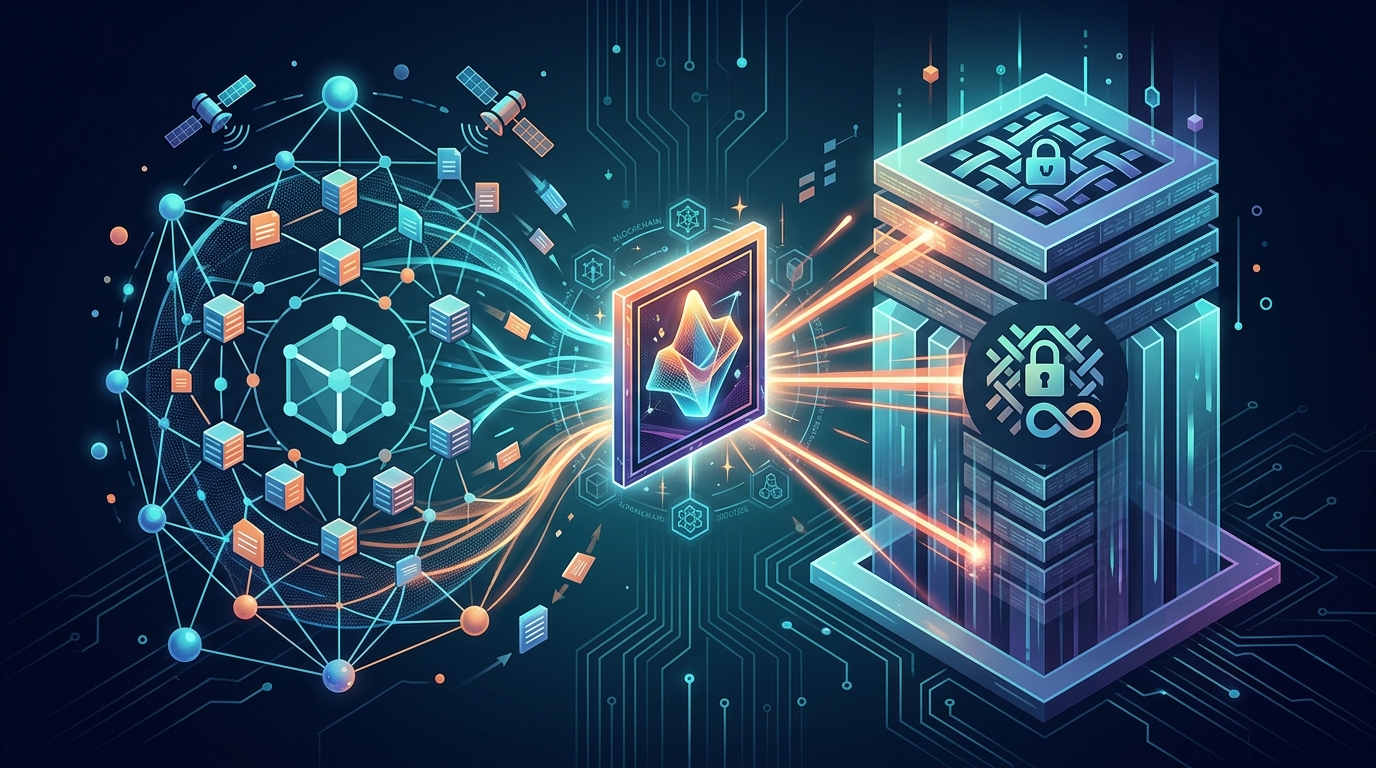
You’ve minted your first NFT, and the artwork looks perfect on OpenSea. But here’s the uncomfortable truth: that image might not live on the blockchain at all. Most NFTs store only a reference link on-chain, while the actual artwork sits somewhere else. If that storage fails, your token becomes a pointer to nothing. This is where the choice between IPFS and Arweave becomes critical for anyone serious about preserving digital art for decades.
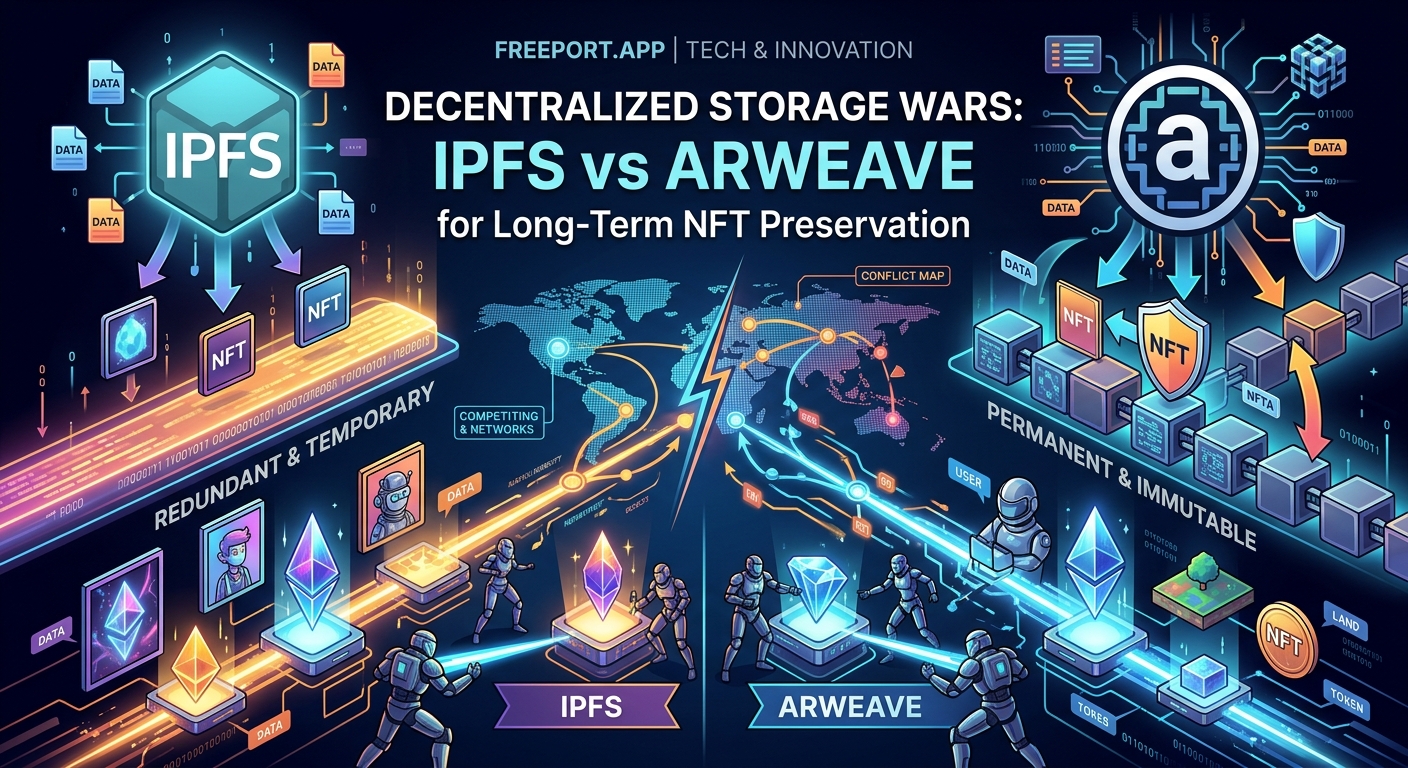
IPFS offers flexible, cost-effective storage with content addressing but requires active pinning to prevent data loss. Arweave provides permanent storage through a single upfront payment but costs more initially. For NFT creators, IPFS works well with ongoing maintenance, while Arweave suits projects demanding guaranteed permanence. Your choice depends on budget, technical capability, and how long you need your assets to survive.
How decentralized storage actually works for NFTs
Traditional web hosting stores your files on a company’s server. When that company shuts down or stops paying bills, your files vanish.
Decentralized storage distributes files across multiple nodes in a network. No single entity controls the data. The blockchain records where to find these files, but the actual images, videos, and metadata live off-chain in these distributed systems.
This separation matters because storing large media files directly on blockchains like Ethereum would cost thousands of dollars per megabyte. Instead, smart contracts revolutionize how ownership records are maintained while pointing to decentralized storage locations.
Both IPFS and Arweave solve this problem differently. Understanding these differences determines whether your NFT collection survives five years or five centuries.
Understanding IPFS architecture and persistence
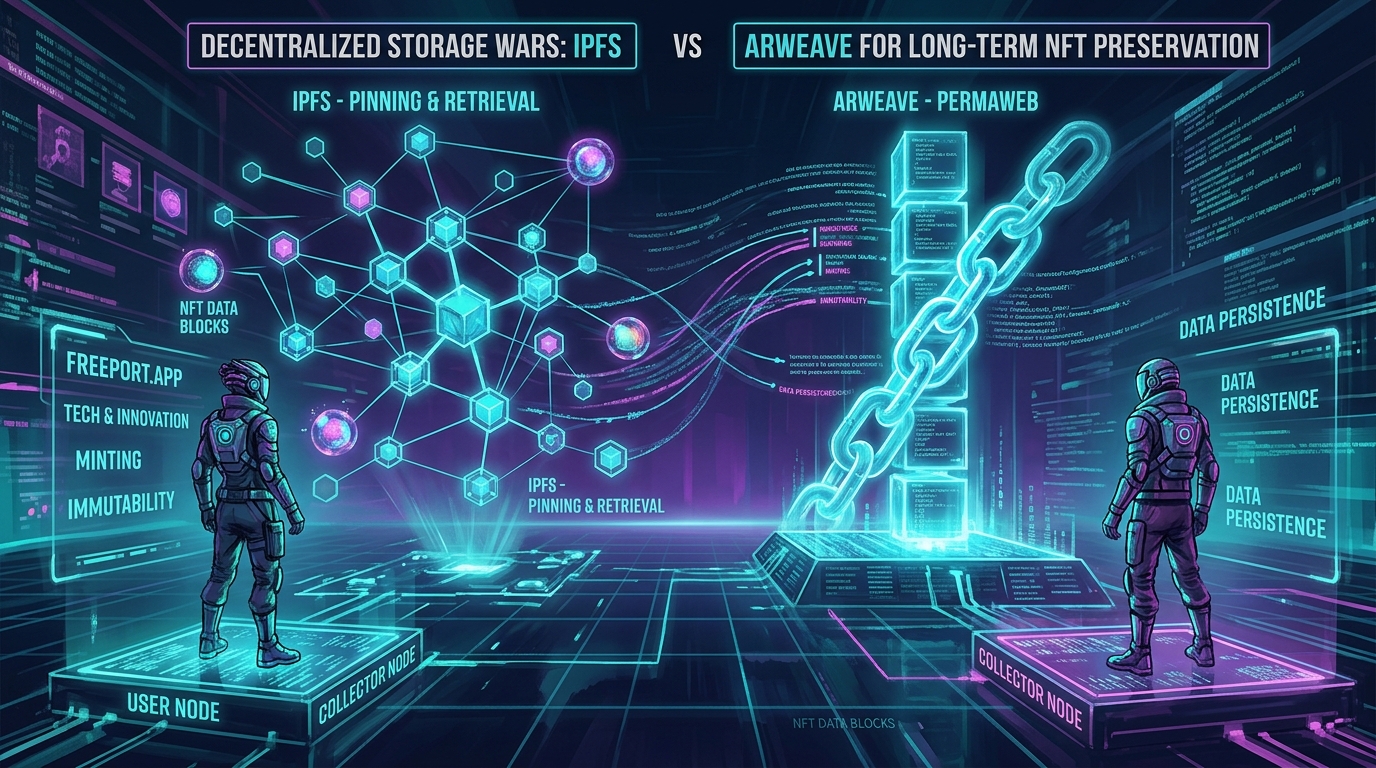
IPFS stands for InterPlanetary File System. It creates a peer-to-peer network where files get identified by their content, not their location.
When you upload a file to IPFS, the system generates a unique hash called a Content Identifier (CID). This hash is like a fingerprint for your file. Change even one pixel, and you get a completely different CID.
Your NFT smart contract stores this CID. When someone views your NFT, their browser uses the CID to request the file from any IPFS node that has it pinned.
Here’s the catch: IPFS doesn’t guarantee permanence by default. Files only persist as long as at least one node “pins” them. Pinning tells a node to keep that file available.
If every node unpins your file, it disappears from the network. Your NFT still exists on the blockchain, but it points to nothing.
The pinning problem for creators
Most creators use pinning services like Pinata, NFT.Storage, or Infura. These companies run IPFS nodes and promise to keep your files pinned.
This introduces dependency. If your pinning service goes bankrupt or changes terms, your files risk deletion. What happens when platforms shut down becomes a real concern for long-term preservation.
Some projects run their own IPFS nodes. This gives complete control but requires technical knowledge and ongoing server costs.
The decentralized promise of IPFS becomes centralized through these practical necessities. You’re trusting a service provider, just like traditional hosting, but with better redundancy.
How Arweave guarantees permanent storage
Arweave takes a fundamentally different approach. It’s a blockchain specifically designed for permanent data storage.
You pay once upfront, and your file stays available forever. The network uses an economic model called the “endowment” to fund ongoing storage costs for at least 200 years.
When you upload to Arweave, miners compete to store your data. The protocol rewards them over time for keeping files accessible. As storage costs decrease historically (following trends similar to Moore’s Law), the initial payment stretches further.
Arweave uses a technology called “blockweave” instead of a traditional blockchain. Each block links to a previous block and a random earlier block, creating a web structure that makes the entire history more permanent.
Your NFT metadata and images get their own Arweave transaction ID. This ID works similarly to an IPFS CID but comes with a permanence guarantee backed by economic incentives.
The cost calculation for permanent storage
Arweave charges based on file size. As of 2026, storing 1 MB costs approximately $0.002 to $0.005 in AR tokens.
For a typical NFT with a 5 MB image and 2 KB of JSON metadata, you’re looking at roughly $0.01 to $0.03 for permanent storage.
This seems cheap, but it adds up for large collections. A 10,000-piece generative art project with 50 MB total could cost $100 to $250 upfront, compared to IPFS pinning services that might charge $5 to $20 monthly.
The break-even point arrives after a few years. Arweave becomes cheaper if you’re thinking in decades. IPFS costs less initially but requires ongoing payments.
Comparing retrieval speed and reliability
IPFS typically delivers faster load times for popular content. When multiple nodes pin a file, requests get distributed across the network. Your browser might fetch pieces from several nodes simultaneously.
This works great for trending NFT collections. The more people view the art, the more nodes cache it, making it faster for everyone.
Arweave stores data across fewer nodes initially, with miners gradually replicating it. Retrieval can be slower, especially for newly uploaded files. However, gateway services like arweave.net cache popular content, improving speeds significantly.
Both systems face potential gateway failures. Most users don’t run IPFS or Arweave nodes locally. They access files through HTTP gateways that translate decentralized addresses into standard web URLs.
If a gateway goes down, files remain on the network but become harder to access for average users. Multiple gateways mitigate this risk, but it’s worth considering for projects targeting mainstream audiences.
Technical implementation for NFT creators
Here’s how to implement each system when minting your first fine art NFT:
IPFS implementation steps
- Choose a pinning service (Pinata, NFT.Storage, or self-hosted node)
- Upload your image files and receive CIDs for each
- Create metadata JSON files that reference image CIDs
- Upload metadata files and receive their CIDs
- Use the metadata CID in your smart contract’s tokenURI function
- Verify pinning status regularly and maintain your service subscription
Arweave implementation steps
- Acquire AR tokens from an exchange
- Use Bundlr Network or ArDrive to batch-upload files
- Pay the one-time storage fee for all assets
- Receive transaction IDs for each file
- Create metadata that references Arweave transaction IDs
- Deploy your smart contract with Arweave-based tokenURIs
- No ongoing maintenance required
Both approaches work with standard ERC-721 or ERC-1155 contracts. The main difference is what you put in the tokenURI field.
Cost comparison over different time horizons
| Time Period | IPFS (Pinata at $20/month) | Arweave (One-time $150) | Winner |
|---|---|---|---|
| 1 year | $240 | $150 | Arweave |
| 5 years | $1,200 | $150 | Arweave |
| 10 years | $2,400 | $150 | Arweave |
| 20 years | $4,800 | $150 | Arweave |
This assumes a collection size requiring $20 monthly IPFS pinning. Smaller projects might pay $5 monthly, changing the math but not the long-term winner.
IPFS offers flexibility to stop paying if your project fails or you decide to migrate storage. Arweave locks you into permanence, which sounds great until you realize you can’t delete files even if you want to.
Some creators prefer IPFS for experimental work and Arweave for finished pieces they consider culturally significant. Museums building blockchain collections often favor Arweave for this permanence guarantee.
Common mistakes that break NFT storage
Many creators make these errors that compromise their NFT’s longevity:
- Using centralized IPFS gateways in metadata: Hardcoding “https://gateway.pinata.cloud/ipfs/CID” instead of just “ipfs://CID” creates a single point of failure
- Forgetting to pin metadata files: Pinning images but not the JSON metadata that references them
- Not testing retrieval: Assuming files are accessible without actually checking from different locations
- Mixing storage systems: Using IPFS for some traits and Arweave for others creates confusion
- Ignoring gateway diversity: Relying on one gateway service without backups
The worst mistake is storing files on traditional servers and thinking the blockchain makes them permanent. Your smart contract only stores what you put in it. If that’s a URL to AWS, you’ve gained nothing.
Hybrid approaches and emerging solutions
Some projects use both systems strategically. They store high-resolution originals on Arweave for permanence while using IPFS for thumbnails and previews that load faster.
Generative art projects sometimes store the code on Arweave and generate outputs on-demand, storing nothing but the algorithm permanently.
Filecoin, built on IPFS, adds economic incentives similar to Arweave. Storage providers stake tokens and get rewarded for maintaining data. This bridges the gap between IPFS’s flexibility and Arweave’s permanence guarantees.
Some newer chains like Solana have integrated Arweave storage directly into their NFT standards. The GenesysGo team built Shadow Drive, offering permanent storage with Solana-native integration.
These innovations matter for blockchain artists redefining contemporary digital art who need reliable infrastructure without constant technical maintenance.
Performance under stress and network failures
IPFS struggles when nodes go offline during network disruptions. If your pinning service experiences downtime, your NFTs become temporarily inaccessible.
During the 2024 Pinata outage, thousands of NFTs showed broken images for six hours. The files weren’t lost, but users couldn’t retrieve them through common gateways.
Arweave has experienced fewer major outages. Its economic model incentivizes miners to maintain uptime. However, smaller network size means less redundancy than IPFS’s thousands of public nodes.
Both systems face challenges during extreme network congestion. Arweave transaction fees can spike when many users upload simultaneously. IPFS retrieval slows when too many requests hit the same gateway.
For critical collections, run your own IPFS node as backup or use multiple pinning services. For Arweave, verify uploads through several gateways before considering them confirmed. No system is perfect, but redundancy saves your work.
Making the right choice for your project
Consider IPFS when:
- You need flexibility to update or remove content later
- Budget is tight upfront but you can handle monthly costs
- Your project is experimental or might not succeed long-term
- Fast loading speeds matter more than permanence guarantees
- You have technical skills to manage pinning services
Consider Arweave when:
- Permanence is non-negotiable for your artistic vision
- You can afford higher upfront costs for peace of mind
- The project represents finished work you consider culturally valuable
- You want to eliminate ongoing maintenance responsibilities
- Long-term value indicators matter for your collector base
Many successful creators use IPFS for drops and community projects while reserving Arweave for flagship collections. This balances cost with preservation priorities.
Security considerations and attack vectors
IPFS content addressing prevents tampering. If someone modifies your file, the CID changes, and the NFT no longer points to it. But this doesn’t prevent nodes from refusing to serve your content.
Arweave’s blockchain structure makes censorship harder. Miners would need to collude to exclude specific data, which becomes economically irrational as the network grows.
Both systems face gateway-level censorship. Governments or companies running gateways can block specific CIDs or transaction IDs. This doesn’t delete files but makes them harder to access for non-technical users.
Running your own gateway or node eliminates this risk. For high-value digital assets requiring robust security, this extra step matters.
Real-world examples from major NFT projects
Art Blocks initially used IPFS with Pinata but added Arweave backups for all historical projects. They recognized that generative art code needed guaranteed permanence.
Bored Ape Yacht Club uses IPFS through their own nodes plus multiple pinning services. This redundancy prevented issues during their explosive growth.
Foundation switched from centralized storage to IPFS in 2021, then added Arweave mirroring in 2024. They learned that hybrid approaches serve different creator needs.
Solana-based projects like Okay Bears used Arweave from launch, taking advantage of native integration. This simplified their infrastructure and eliminated ongoing storage costs.
These choices reflect different priorities. Profile picture projects prioritize speed and flexibility. Fine art platforms emphasize permanence and cultural preservation.
Future developments and ecosystem evolution
IPFS continues improving with features like IPLD (InterPlanetary Linked Data) that creates relationships between files. This matters for complex NFTs with multiple components.
Arweave is developing SmartWeave contracts that run logic on stored data. This could enable dynamic NFTs that change based on stored conditions without leaving the Arweave network.
Both systems face competition from new solutions. Filecoin’s storage deals, Ceramic’s mutable data streams, and chain-specific solutions like Solana’s Shadow Drive all compete for creator attention.
The trend points toward hybrid solutions. Future NFT standards might specify primary and backup storage, automatically checking multiple systems for data availability.
Interoperability improves constantly. Tools like NFT.Storage now upload to both IPFS and Filecoin simultaneously. Bundlr enables easy Arweave uploads from any chain.
Building for permanence without compromise
The choice between IPFS and Arweave isn’t binary. Thoughtful creators use each system’s strengths strategically.
For works you consider permanent contributions to digital culture, Arweave’s guarantees justify the cost. For community experiments, limited drops, or projects still evolving, IPFS offers flexibility without sacrificing decentralization.
The real risk isn’t choosing the wrong system. It’s choosing no decentralized storage at all, leaving your NFTs vulnerable to the same failures that plague traditional web hosting. Both IPFS and Arweave represent massive improvements over centralized alternatives.
Start by understanding your project’s timeline. Will this matter in six months, six years, or sixty years? Your answer determines which system aligns with your vision. Then implement it properly, test thoroughly, and document everything for future collectors who’ll inherit your work.
Your NFTs deserve storage infrastructure that matches their artistic ambition. Choose wisely, implement carefully, and your digital art will outlive the platforms that first displayed it.