The Top 5 Blockchain Networks for Building a Diverse Digital Collection
The biggest challenge for a digital collector today isn’t finding art — it’s choosing where to keep it. A single network can trap your assets in that ecosystem’s culture, fees, and community. A truly diverse collection spans multiple blockchains, each with unique strengths. Whether you collect generative art, one-of-one pieces, or time-based media, your network choices shape your collection’s long-term value and liquidity. Let’s walk through the five blockchain networks that give you the most flexibility, and how to pick the right ones for your portfolio.
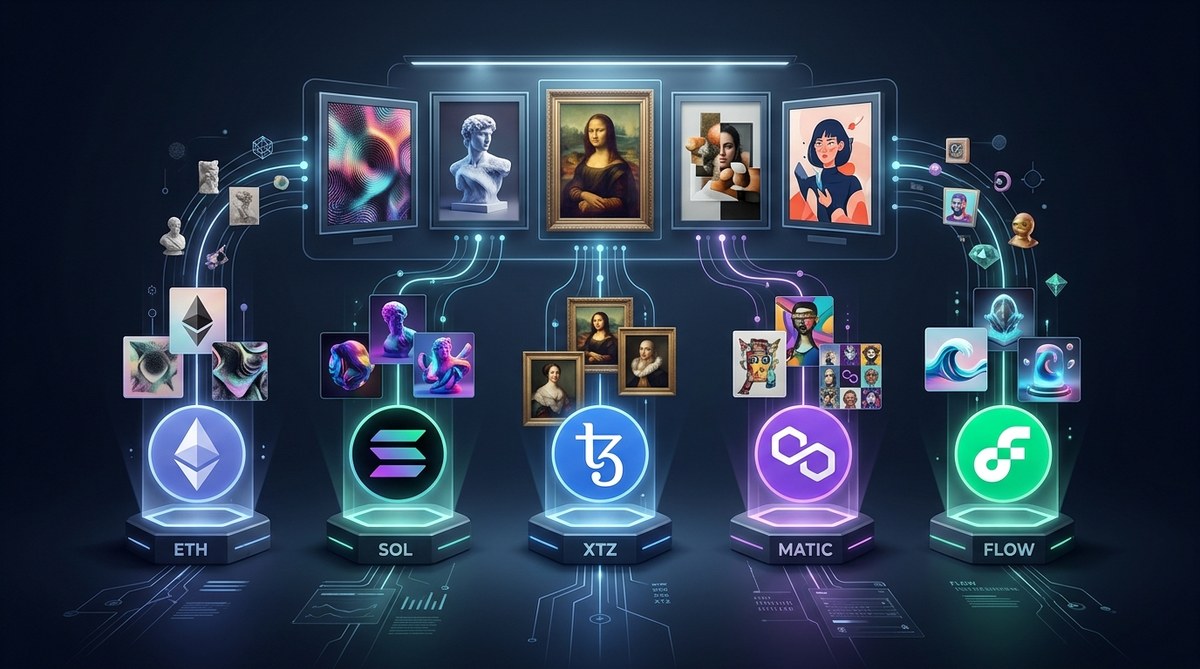
Building a diverse digital collection requires thinking across blockchains. Ethereum remains the gold standard for fine art and blue-chip NFTs. Solana offers speed and low fees for active traders. Tezos provides sustainable minting with strong community curation. Polygon reduces Ethereum costs via Layer 2. Bitcoin’s Ordinals bring scarcity to truly on-chain art. A multi-chain approach protects you from single-network risk.
Why Network Diversity Matters for Your Collection
If every piece in your collection lives on one blockchain, you’re exposed to that network’s congestion, gas spikes, and potential policy changes. Spreading your assets across multiple chains is like owning real estate in different cities — it protects your holdings and opens up unique marketplaces. Different blockchains attract different kinds of artists, collectors, and platforms. By collecting across them, you gain access to drops, communities, and price discovery that would be invisible otherwise.
Before we jump into the top five, here’s a practical process to decide which network fits each piece you want to collect:
3 Steps to Choose the Right Blockchain for a New Acquisition
- Consider the artwork’s medium. Generative art and high-res video need cheap storage and low fees. Look at Solana or Polygon. Fine art photography and one-of-one pieces benefit from Ethereum’s prestige. Audio works well on Tezos.
- Check the artist’s preferred platform. Some creators mint only on a single network. If you love an artist’s work, follow them to their chain rather than forcing them to yours.
- Plan your resale and display strategy. Do you plan to trade actively? Solana and Polygon have fast settlement. Want to hold long-term? Ethereum and Bitcoin offer the deepest liquidity and institutional interest.
The Top 5 Blockchain Networks for a Diverse Digital Collection
Each network here brings something different to the table. I’ve ranked them by overall utility for collectors, not by market cap.
1. Ethereum: The High-Security Home for Blue-Chip Art
Ethereum is still the network most serious collectors rely on. It hosts the largest share of established digital art marketplaces — SuperRare, Foundation, and Art Blocks all live here. The network’s proof-of-stake transition cut energy use by over 99%, and the Ethereum Foundation’s commitment to decentralization means your assets are as secure as any public blockchain can offer.
What makes Ethereum great for diversity:
– Dominates the fine art NFT segment
– Deep liquidity across multiple marketplaces
– Strong royalty enforcement through smart contracts
– Extensive tooling for provenance tracking
The catch is gas fees. Even with Layer 2 solutions, minting on Ethereum mainnet during peak hours can be expensive. That’s where Polygon comes in (see below). But for pieces you intend to hold long-term and resell on the secondary market, Ethereum is the safest bet.
Expert advice from a digital curator: “If you can afford the gas, buy your top three pieces each year on Ethereum. The chain’s legacy effects — auction houses, museum collections, institutional investors — are locked in. Solana and Tezos are great for discovery, but Ethereum is where value consolidates.”
2. Solana: Speed and Low Fees for Active Collectors
Solana’s high throughput and near-zero transaction costs make it ideal for frequent trading and large-volume drops. Collections like DeGods, y00ts, and various generative projects have found a home here. The user experience is smoother than Ethereum, with confirmations in seconds.
Why Solana belongs in a diverse collection:
– Fast settlement (under 1 second)
– Fees under $0.01 per transaction
– Growing DeFi and NFT crossover (lending, fractionalization)
– Active community with daily drops
The trade-off is security. Solana has suffered outages and network congestion. For collectors who want to flip pieces or participate in live mints without worrying about gas wars, Solana is hard to beat. Just keep your high-value items on a more established chain.
3. Tezos: The Eco-Friendly Choice for Curated Communities
Tezos gained traction early among artists who cared about sustainability and fair launches. With its liquid proof-of-stake model, minting an NFT on Tezos uses a fraction of the energy of even Ethereum PoS. Platforms like Objkt and Teia host everything from generative art to photography and music.
What Tezos offers collectors:
– Lowest environmental impact
– Strong emphasis on creator royalties
– Many established generative artists (e.g., Matt DesLauriers, Tyler Hobbs)
– No fork issues — Tezos upgrades itself without splitting
Tezos’s market capitalization is smaller, which limits liquidity. That’s fine if you’re collecting for love, not speculation. But for pure diversity, Tezos gives you access to a distinct artistic community that rarely appears on other chains. For a closer look at how artists are using blockchain, check out
4. Polygon: Ethereum’s Layer 2 Powerhouse for Mass Adoption
Polygon is an Ethereum scaling solution that offers EVM compatibility with much lower fees. It’s become the go-to network for brands, gaming projects, and large-scale art drops. You get the security of Ethereum’s main chain while paying pennies per transaction.
Why Polygon is essential for diversity:
– Compatible with all Ethereum wallets and tools
– Hosts huge brands (Starbucks, Disney, Reddit)
– Ideal for high-volume collections (profile pictures, generative sets)
– Bridging to Ethereum mainnet is straightforward
If you’re building a collection that includes fan art, brand collaborations, or community-driven projects, Polygon is the network to use. Many collectors start here because of the low barrier to entry. Just remember that items originally minted on Polygon can be bridged to Ethereum for higher prestige, but that adds a step.
5. Bitcoin (Ordinals): True On-Chain Scarcity for the Purist
Bitcoin’s Ordinals protocol launched in early 2023 and has matured into a legitimate home for digital art. Unlike NFTs on other chains, Ordinals inscribe the artwork directly onto the Bitcoin blockchain itself — no metadata pointers, no off-chain storage. This appeals to collectors who value permanence and maximal decentralization.
What Bitcoin brings to a diverse collection:
– Artwork lives fully on the most secure blockchain
– Very small total supply of inscriptions relative to other chains
– Strong community of early adopters and cypherpunks
– Potential for long-term value given Bitcoin’s brand
The downsides: fees can spike, tools are less user-friendly, and the market is still niche. But for a collector who wants a piece that will survive any platform shutdown, Bitcoin Ordinals are unmatched. If you’re worried about platform risk, read
Comparing the Five Networks at a Glance
| Network | Typical Fee (Mint) | Speed | Best For | Risk Level |
|---|---|---|---|---|
| Ethereum | $10 – $150+ | Slow (high traffic) | Blue-chip art, high-value NFTs | Low (established) |
| Solana | < $0.01 | Very Fast | Active trading, drops | Medium (outages) |
| Tezos | < $0.05 | Fast | Eco-conscious artists, curation | Medium (low liquidity) |
| Polygon | < $0.01 | Fast | Brands, gaming, volume collections | Low (backed by ETH) |
| Bitcoin (Ordinals) | $5 – $100+ | Slow (block time) | Permanent on-chain art | Very Low (most secure) |
How to Build a Multi-Network Strategy That Works
You don’t need to collect on every chain equally. A smart approach is:
- Use Ethereum for your anchor pieces. This is your “museum wing” — the artworks you expect to appreciate and possibly lend to exhibitions.
- Use Solana for discovery and flips. Keep a small budget here to test emerging artists and participate in mints.
- Use Tezos for community-driven projects. Follow curators and join their drops. The conversation is often more thoughtful.
- Use Polygon for brand collaborations and utility. If a project offers membership benefits or in-person events, it’s probably here.
- Use Bitcoin for one or two ultra-rare inscriptions. Think of them as the digital equivalent of a signed print.
A multi-chain collection also helps with tax planning. By selling on different exchanges and networks, you can manage taxable events more flexibly. For more on that, see
Common Pitfalls to Avoid When Diversifying Across Networks
Even experienced collectors make mistakes. Here are three I see most often:
- Forgetting about bridge security. Moving assets between Ethereum and Polygon is safer than between less-audited bridges. Always use official bridges and never share your seed phrase.
- Ignoring wallet compatibility. Not all wallets support all networks. A hardware wallet like Ledger might only support Ethereum and Bitcoin, not Solana or Tezos. Plan your wallet setup in advance.
- Chasing “low fees” at the cost of liquidity. A piece minted on a cheap network might be difficult to sell later if the market for that chain dries up. Always check secondary market volume before buying.
If you’re starting from scratch, the will walk you through the process on each major network.
The Future of Cross-Chain Collecting
We’re already seeing tools that let you manage a single portfolio across multiple chains. Aggregators like Gem and Genie are merging Ethereum liquidity, and wallets like Rainbow show your entire collection regardless of network. The next step is true interoperability, where a piece minted on one chain can be displayed or used on another without bridging.
For now, the best strategy is to stay curious. Don’t lock yourself into one ecosystem. The collectors who thrive in 2026 are the ones who understand that diversity isn’t just about the artwork — it’s about the foundation it sits on.
Start by identifying one network you haven’t tried yet. Open a wallet, buy a small amount of that chain’s native token, and buy one piece from a new artist. You might discover your next favorite collectible in a place you never thought to look.