The Role of IPFS in Preserving Digital Art Collections Forever
Your digital artwork lives on a server somewhere. That server could go offline tomorrow. The company hosting it could shut down. Your files could vanish without warning.
This isn’t theoretical. It happens every day.
IPFS digital art preservation offers a different approach. Instead of trusting one company or one server, your artwork gets distributed across a network of computers worldwide. No single point of failure. No corporate gatekeeper deciding if your art survives.
IPFS (InterPlanetary File System) preserves digital art by storing files across a distributed network instead of centralized servers. Each artwork receives a unique content identifier that never changes, ensuring permanent accessibility. Artists and collectors use IPFS to protect their work from platform shutdowns, link rot, and single points of failure. This decentralized approach creates verifiable, tamper-proof records that outlast any individual company or service.
Why traditional storage fails digital art
Cloud storage seems convenient until the bill stops getting paid.
Traditional hosting relies on centralized servers. One company controls your files. They set the rules. They decide the pricing. They can change terms of service overnight.
Amazon, Google, and Microsoft dominate cloud storage. But even tech giants shut down services. Google alone has killed over 200 products. Each shutdown erases data that wasn’t backed up elsewhere.
Location-based URLs create another problem. When you link to artwork using a standard web address, you’re pointing to a specific server location. Move the file, and the link breaks. The art becomes inaccessible even though it still exists somewhere.
This phenomenon, called link rot, affects roughly 50% of web links within a decade. Your carefully curated collection becomes a graveyard of broken references.
How IPFS changes the preservation game
IPFS treats files differently from traditional storage systems.
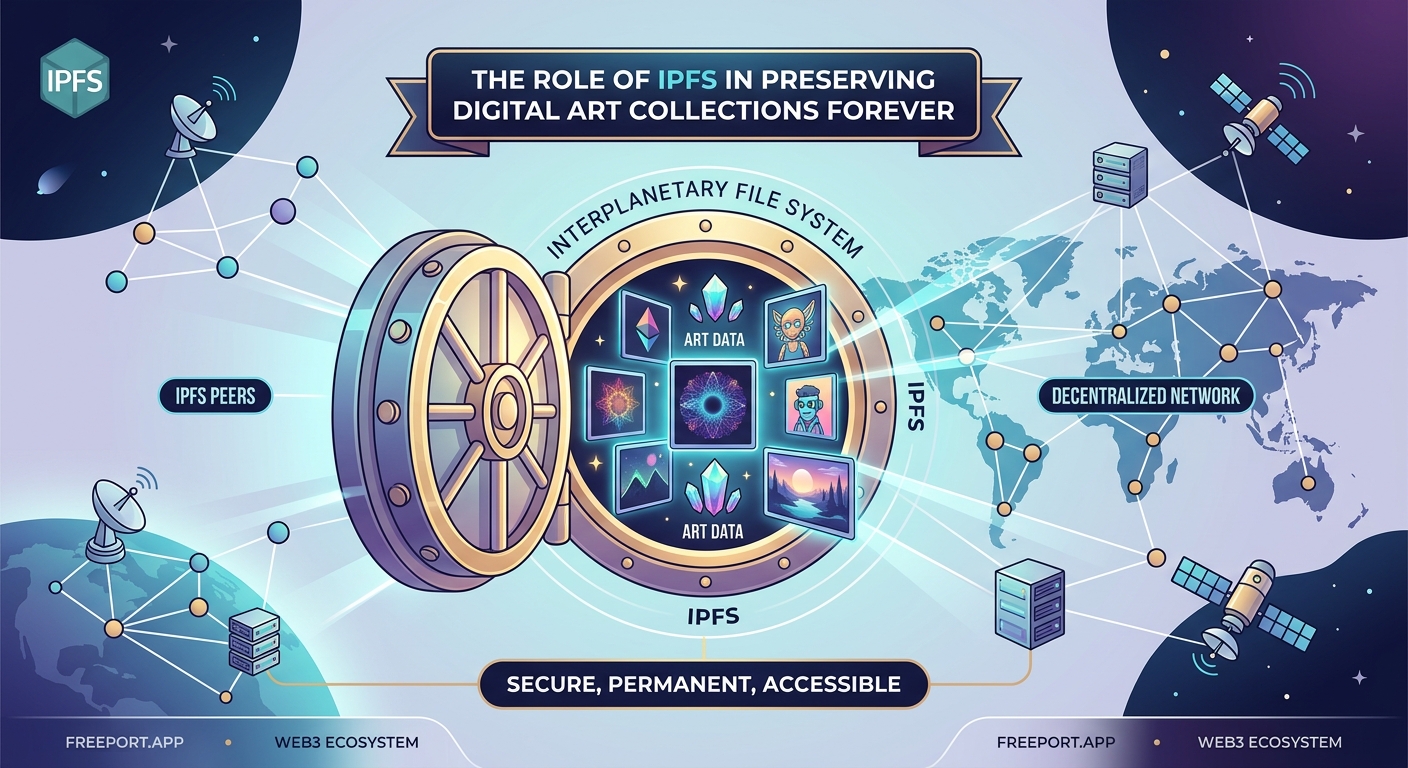
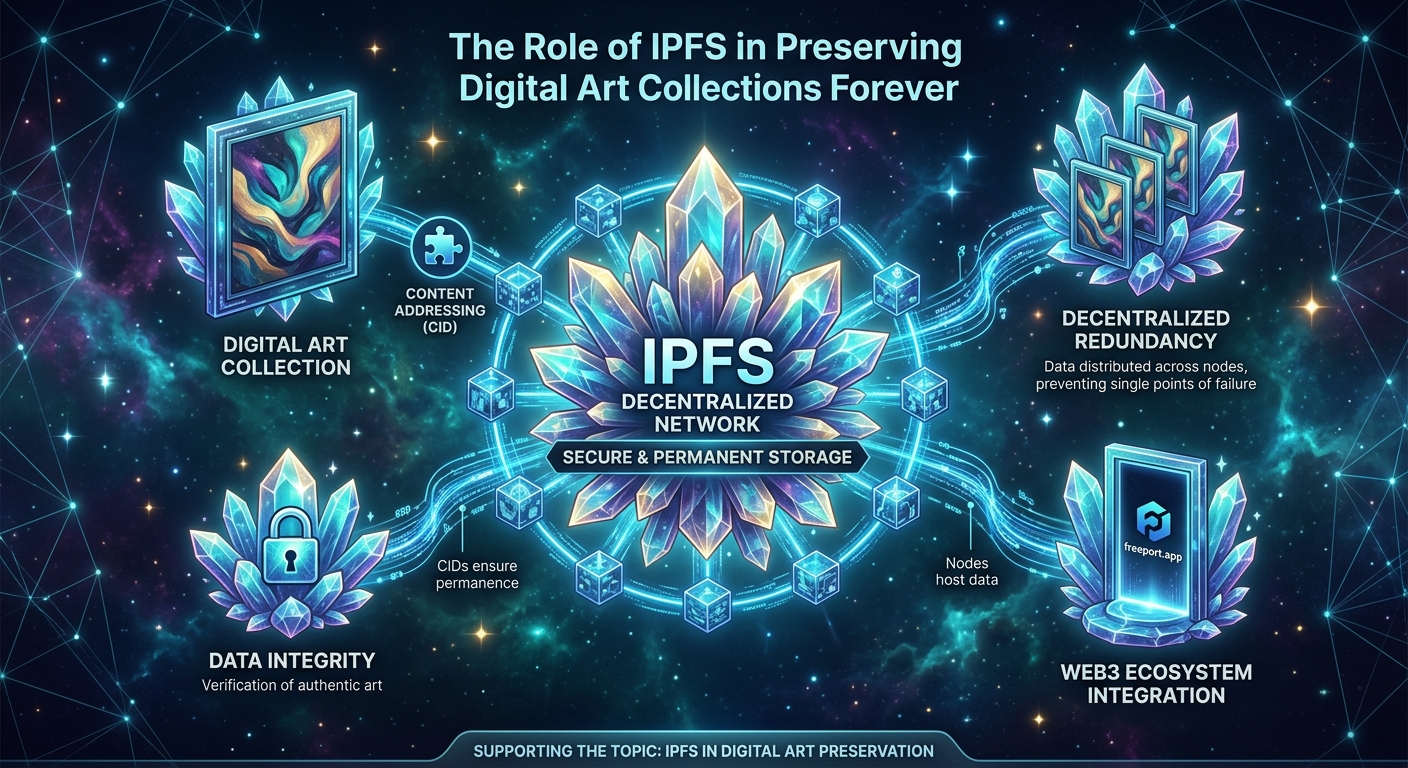
Instead of asking “where is this file?” IPFS asks “what is this file?” Each piece of content gets a unique fingerprint called a content identifier (CID). This fingerprint derives from the file’s actual data, not its location.
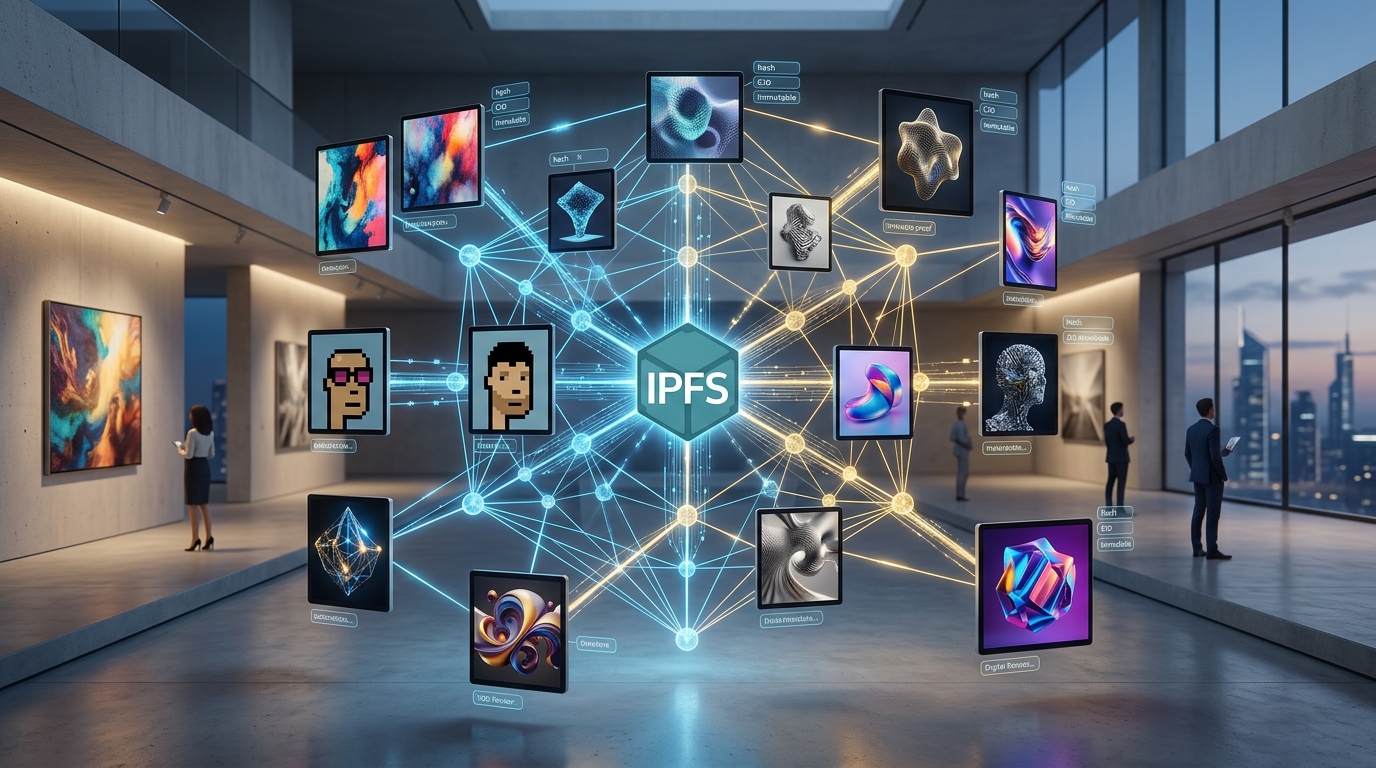
When you add artwork to IPFS, the system breaks it into smaller chunks. Each chunk gets hashed and distributed across multiple nodes in the network. Anyone running IPFS software can host these chunks.
The CID acts like a permanent address. It doesn’t matter which computer stores the file. The identifier always points to the exact same content. Change even one pixel, and you get a completely different CID.
This content-addressing model solves link rot. The identifier is the content. As long as one node anywhere hosts your file, it remains accessible through that CID.
Setting up IPFS for your art collection
Getting started with IPFS requires a few straightforward steps.
- Install IPFS Desktop or use a pinning service like Pinata or NFT.Storage
- Add your digital artwork files to the IPFS network through the interface
- Receive a CID for each file you upload
- Pin important files to ensure they stay available on the network
- Store your CIDs in a secure location for future reference
- Verify file accessibility by retrieving content through different IPFS gateways
Pinning deserves special attention. When you pin a file, you tell your IPFS node to keep that content available permanently. Without pinning, files may get removed during garbage collection to free up space.
Most artists use pinning services rather than running their own nodes. These services guarantee your files stay online even when your computer is off. They charge based on storage volume, typically a few dollars per month for several gigabytes.
The complete guide to minting your first fine art NFT covers how IPFS integrates with blockchain platforms during the minting process.
Content identifiers explained for artists
Understanding CIDs helps you verify file integrity and authenticity.
A typical CID looks like this: QmYwAPJzv5CZsnA625s3Xf2nemtYgPpHdWEz79ojWnPbdG
The identifier contains multiple components. The first characters indicate the CID version and encoding format. The middle section represents the hash function used. The final portion is the actual hash of your content.
This structure makes CIDs self-describing. You can tell how the content was processed just by looking at the identifier.
For digital art preservation, CIDs provide several benefits:
- Permanent verification that files haven’t been altered
- Ability to prove you possessed specific artwork at a certain time
- Protection against unauthorized modifications or substitutions
- Easy comparison between different versions of the same piece
- Transparent tracking of original versus derivative works
When someone shares an IPFS link to your artwork, you can instantly verify it matches your original file by comparing CIDs.
Comparing storage approaches for long-term access
Different preservation methods serve different needs.
| Approach | Permanence | Cost Structure | Control Level | Technical Skill |
|---|---|---|---|---|
| IPFS with self-hosting | High if maintained | Hardware + electricity | Complete | Advanced |
| IPFS pinning services | High | Monthly subscription | Moderate | Beginner |
| Arweave | Permanent | One-time payment | Limited | Intermediate |
| Traditional cloud | Low | Monthly subscription | Low | Beginner |
| Personal hard drives | Very low | Hardware replacement | Complete | Beginner |
Decentralized storage wars: IPFS vs Arweave for long-term NFT preservation provides detailed comparisons between the leading decentralized options.
IPFS works best when combined with other strategies. Many collectors maintain copies on IPFS, Arweave, and local drives. This redundancy protects against any single system failing.
Practical workflows for archivists and institutions
Museums and archives face unique preservation challenges.
Large collections require systematic approaches. You can’t manually pin thousands of artworks. Automation becomes necessary.
Professional archivists typically follow this workflow:
Start by cataloging all digital assets with detailed metadata. Include artist names, creation dates, dimensions, file formats, and provenance information. Store this metadata separately from the artwork itself.
Next, batch-upload artwork to IPFS using command-line tools or API integrations. Record each CID alongside its corresponding metadata entry. This creates a verifiable link between catalog records and actual files.
Implement monitoring systems that regularly verify file availability. These systems attempt to retrieve each CID and alert you if content becomes inaccessible. Early warning allows you to re-pin files before they disappear entirely.
Why museums are building blockchain art collections discusses how institutions integrate IPFS into broader digital collection strategies.
“We treat IPFS as one layer in a comprehensive preservation strategy. The technology provides redundancy and verifiability, but it doesn’t replace proper archival procedures. You still need metadata standards, regular audits, and migration plans for evolving formats.” — Digital Collections Manager, major contemporary art museum
Common mistakes that compromise preservation
Even experienced collectors make preventable errors.
The biggest mistake is assuming IPFS automatically preserves everything forever. It doesn’t. Files only persist while nodes choose to host them. Popular content stays available because many people want it. Obscure artwork requires active pinning.
Another frequent error involves metadata handling. Artists often upload artwork to IPFS but store metadata on centralized servers. When the server goes down, the context disappears. The image survives, but nobody knows who created it or what it represents.
File format choices also matter. Proprietary formats may become unreadable as software evolves. Stick with open standards like PNG, JPEG, and MP4 for maximum longevity. Include original project files when possible, even if they use specialized software.
Neglecting to document CIDs creates problems later. Write down your content identifiers. Back them up in multiple locations. Without the CID, you can’t retrieve your files even though they exist somewhere on the network.
Storage and security best practices for high-value digital collections covers additional protection strategies for valuable pieces.
Integrating IPFS with blockchain platforms
Most NFT platforms now support IPFS natively.
When you mint an NFT, the smart contract typically stores a reference to your artwork rather than the artwork itself. Storing large files directly on blockchain networks costs too much. IPFS provides the storage layer while blockchain handles ownership records.
This separation creates important considerations. Your NFT token lives on the blockchain permanently. But the artwork it references only persists if someone keeps pinning it to IPFS.
Some platforms handle pinning automatically. Others require you to use external pinning services. Always verify that your artwork stays accessible after minting.
How smart contracts are revolutionizing art ownership and provenance explains the relationship between blockchain tokens and IPFS-hosted content.
The combination of IPFS and blockchain creates powerful verification capabilities. The blockchain proves ownership history. IPFS proves the artwork hasn’t been altered. Together, they establish provenance more reliably than traditional methods.
Gateway access and retrieval methods
IPFS gateways bridge the gap between decentralized storage and regular web browsers.
Most people don’t run IPFS nodes. They access content through HTTP gateways that translate IPFS addresses into standard web URLs. These gateways fetch content from the IPFS network and serve it through familiar protocols.
Public gateways like ipfs.io and cloudflare-ipfs.com work for casual access. But they introduce centralization risks. If the gateway goes down, content becomes harder to reach even though it still exists on IPFS.
Running your own gateway gives you complete control. You can access your collection anytime without depending on third-party services. This approach requires technical expertise and dedicated hardware.
Many collectors use multiple retrieval methods:
- Primary access through a trusted pinning service’s gateway
- Backup access through public gateways
- Local IPFS node for critical pieces
- Cached copies on traditional web hosting for convenience
This layered approach balances accessibility with decentralization. Casual viewers use gateways. Serious verification happens through direct IPFS retrieval.
Cost analysis for different collection sizes
Understanding expenses helps you plan sustainable preservation strategies.
Small collections (under 100 pieces, less than 10GB) cost almost nothing. Free pinning services provide sufficient storage. You might spend $0-5 monthly.
Medium collections (100-1000 pieces, 10-100GB) require paid pinning services. Expect $10-50 monthly depending on total storage and bandwidth needs. Some services charge per file rather than total size.
Large institutional collections (10,000+ pieces, multiple terabytes) need dedicated infrastructure. Running your own IPFS nodes becomes cost-effective at this scale. Hardware costs range from $2,000-10,000 for a robust setup. Monthly electricity and bandwidth add another $100-500.
Compare these costs to traditional cloud storage. Amazon S3 charges roughly $23 per terabyte monthly, plus egress fees when people access your files. IPFS pinning services typically cost less and include bandwidth.
The real advantage appears during platform migrations. Moving terabytes between cloud providers costs thousands in transfer fees. With IPFS, you just point to existing CIDs from your new location. No data transfer required.
Handling updates and version control
Digital art evolves. Your preservation system should accommodate changes.
IPFS uses immutable content addressing. You can’t modify a file and keep the same CID. Any change creates a new identifier. This immutability helps with verification but complicates version management.
Artists working on series or evolving pieces need version tracking systems. Create a manifest file that lists all versions with their corresponding CIDs and creation dates. Store this manifest on IPFS too, updating it with each new version.
Some artists use IPNS (InterPlanetary Name System) to create mutable pointers. An IPNS address always points to your latest version while preserving access to older ones. This works well for living artworks that change over time.
The rise of dynamic NFTs: how on-chain data creates evolving digital artworks covers how programmable art interacts with IPFS storage.
Documentation becomes critical for versioned work. Explain why each version exists. Note significant changes. Future archivists need context to understand your creative evolution.
Building redundancy into your preservation plan
No single technology guarantees eternal preservation.
IPFS provides strong foundations, but complete protection requires multiple layers. Think of preservation as a pyramid with IPFS at the base and additional safeguards stacked on top.
Layer one: IPFS pinning through multiple services. Don’t rely on a single provider. Pin your collection to at least two separate pinning services in different geographic regions.
Layer two: Permanent storage solutions. Upload critical pieces to Arweave or Filecoin for guaranteed long-term persistence. These networks charge upfront for permanent hosting rather than ongoing subscriptions.
Layer three: Traditional backups. Keep copies on external hard drives stored in different physical locations. Update these backups annually. Hard drives fail, but they provide access when internet connectivity isn’t available.
Layer four: Documentation and metadata. Store detailed records about each piece separately from the artwork itself. Include artist statements, technical specifications, exhibition history, and conservation notes.
What happens to your blockchain art when the platform shuts down? examines real-world scenarios where layered preservation prevented total loss.
Verifying integrity over time
Preservation without verification is just hopeful storage.
Regular integrity checks confirm your files remain intact and accessible. Automated systems can perform these checks monthly or quarterly depending on collection size.
Basic verification involves retrieving each CID and comparing the returned file hash against your records. Matching hashes prove the content hasn’t been corrupted or altered. This process takes minutes for small collections, hours for large archives.
Advanced verification includes format validation. Ensure files still open correctly in current software. Digital formats evolve. What works today might fail in five years. Early detection allows you to migrate files before they become unreadable.
Keep verification logs documenting each check. Note any failures or anomalies. These records help identify patterns that might indicate systematic problems.
Some collectors perform random spot checks rather than full verification. Pull 10% of your collection randomly each month. This approach catches most issues while requiring less computational resources.
Future-proofing your digital art collection
Technology changes faster than art deteriorates.
Physical paintings last centuries with minimal intervention. Digital files require active maintenance. File formats become obsolete. Storage media degrades. Software stops supporting old standards.
Future-proofing starts with format selection. Choose widely-adopted open standards over proprietary formats. PNG beats Photoshop’s PSD for long-term accessibility. MP4 outlasts proprietary video codecs.
Maintain original creation files alongside final exports. The layered Photoshop file preserves more information than the flattened PNG. Future tools might extract value from this additional data.
Document your technical choices. Explain which software created each piece, which plugins were used, which settings were applied. This information helps future archivists recreate your workflow if needed.
How to build a valuable digital art collection from scratch in 2026 discusses how preservation considerations affect collection building strategies.
Plan for migration. Assume you’ll need to move files to new formats eventually. Build migration costs into your preservation budget. Set calendar reminders to review format viability every few years.
Why decentralization matters for cultural heritage
Centralized preservation creates single points of cultural failure.
Throughout history, concentrated knowledge repositories have been destroyed. The Library of Alexandria burned. Colonial powers erased indigenous art. Authoritarian regimes banned entire artistic movements.
Modern centralization creates similar vulnerabilities. A few tech companies control most digital content. Their decisions affect global cultural access. They can remove content, change access terms, or simply shut down.
IPFS distributes cultural assets across thousands of independent nodes. No single entity controls access. No government can easily censor content. No company can delete artwork to free up server space.
This distribution protects against both intentional censorship and accidental loss. Natural disasters, political upheaval, and corporate bankruptcies all become less threatening when content exists in multiple locations worldwide.
7 blockchain artists redefining contemporary digital art in 2026 profiles creators using decentralized storage to maintain artistic independence.
Cultural institutions increasingly recognize these benefits. Museums experiment with IPFS to ensure their digital collections survive institutional changes. Artists in politically sensitive regions use it to preserve work that might otherwise be destroyed.
Making preservation accessible to every artist
You don’t need technical expertise to protect your work.
User-friendly services have emerged that handle IPFS complexity behind simple interfaces. Upload your artwork like you would to any cloud service. The platform manages pinning, generates CIDs, and ensures ongoing availability.
Free tiers exist for artists just starting out. Many pinning services offer several gigabytes of storage at no cost. This suffices for most individual artists’ portfolios.
As your collection grows, paid plans remain affordable. Most artists spend less on IPFS preservation than on coffee. The investment protects years of creative work.
Education resources continue expanding. Video tutorials, written guides, and community forums help newcomers learn IPFS basics. The learning curve has flattened significantly since the technology’s early days.
The most important step is simply starting. Upload one piece. Get comfortable with the process. Gradually migrate your entire portfolio. Preservation doesn’t require perfection, just consistent effort.
Your digital art deserves the same protection as physical masterpieces hanging in climate-controlled museums. IPFS digital art preservation puts that level of security within reach of every creator and collector. The technology exists. The infrastructure is ready. The only question is whether you’ll use it before the next platform shutdown erases something irreplaceable.